
STEM Next is Testing a New Model for AI Learning in Afterschool. Early Results Show What Works.
[[{“value”:”
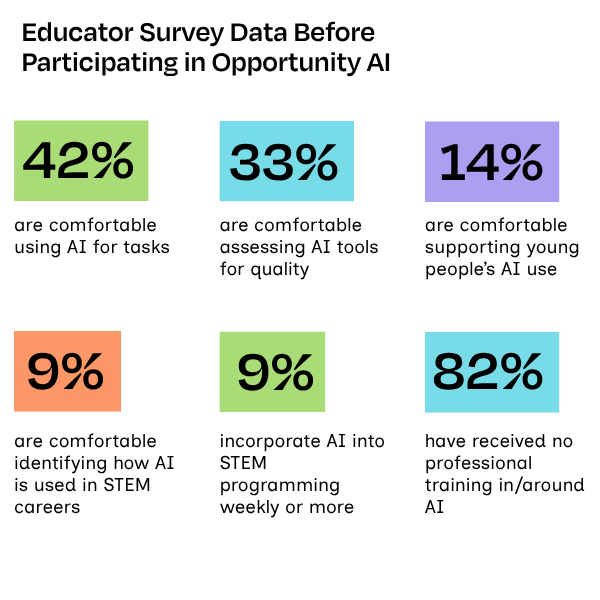
Before they got involved in STEM Next’s Opportunity AI pilot project in the fall, educators said they weren’t sure where to start with using AI in their programs, much less teaching kids how to use it responsibly. Now, they’re testing activities with students, exploring how to integrate career-connected AI learning in their programs, and sharing what works with other educators across their states.
This is an early look at what it takes to scale human-centered AI learning through afterschool.
With leadership support from partners including Qualcomm and Arconic Foundation, STEM Next launched the Opportunity AI pilot project in fall 2025 with afterschool network leaders and educators in Montana, Ohio, Pennsylvania and West Virginia with a goal to make AI learning practical, accessible, and scalable through afterschool and summer programs.
With strong evidence of its effectiveness, the focus now shifts to scaling this model so the afterschool and summer learning field can deliver AI literacy at the reach and speed this moment demands.
Why AI Literacy in Afterschool?
Understanding how AI works, where it shows up, and how to use it effectively is becoming a basic requirement for participation in the economy and society.
Afterschool and summer programs offer a powerful, proven solution to prepare a generation that can use these technologies responsibly and creatively.
These programs reach millions of young people in flexible, trusted environments where they can explore, question, and apply new technologies in real-world contexts. They create space for hands-on learning, build confidence, and connect young people to future career pathways in ways that traditional systems often cannot.
Yet despite the promise of programs to reach youth at scale with powerful AI literacy experiences, afterschool and summer educators often lack clear, practical entry points for introducing AI with confidence. That’s the gap STEM Next aims to bridge through its efforts like Opportunity AI.
Building Confidence Through a Centralized Community of Practice
As part of Opportunity AI, network leaders and program educators received in-depth training, peer support and tools to build their own understanding of AI while testing practical ways to bring it into everyday programming. What began for many as uncertainty or hesitation is quickly shifting into hands-on experimentation, peer learning, and new confidence in guiding youth through a rapidly changing technological landscape.
The experience included monthly Community of Practice sessions led by STEM Next and AI experts, along with coaching to help programs embed career-connected AI activities with youth.
The project’s community of practice model is designed to help these efforts spread. As participants gained experience implementing AI literacy activities, they shared what works with peers, enabling other programs to adopt and build on these practices. This accelerates the spread of effective approaches and expands access to AI learning for more young people.
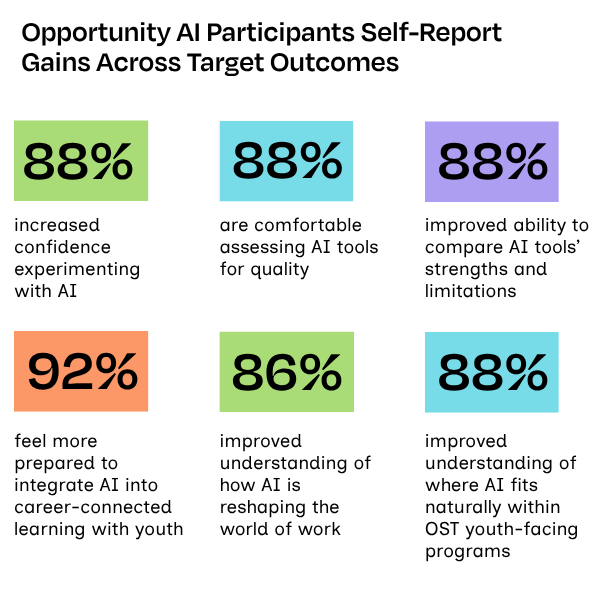
Early survey data from participating educators points to strong progress across key areas. These findings are directional, with final results to be confirmed through end-of-project analysis in late summer 2026.
Making AI Learning Approachable
Network leaders described how the experience built both confidence and practical strategies to support educators in their states. Contrell Armor, director of the Pennsylvania Statewide Afterschool/Youth Development Network, said one of the most valuable aspects has been connecting with peers across states, helping programs realize they are not navigating AI alone.
In West Virginia, the learning quickly moved from theory to practice. After participating in the community of practice, leaders from the West Virginia Statewide Afterschool Network (WVSAN) brought what they were learning back to the field through a session at the state’s afterschool quality conference.
About 25 providers participated in a hands-on activity from STEM Next’s toolkit designed for elementary-age youth, using everyday objects to sort items into categories and identify patterns, demonstrating how AI systems organize information and make decisions.
That experience helped educators see AI as approachable rather than intimidating, WVSAN’s Tami Jo Wilt said.
“We’re not diving in with second graders learning how to prompt,” she said. “We’re learning how AI works, and giving that foundation of understanding, and then building on that as kids get older.”
Summer, an afterschool educator in West Virginia, said her experience in Opportunity AI helped her introduce AI learning concepts in ways that feel natural and engaging.
One recent activity she led helped young people develop a critical lens when using AI tools. Students were tasked with using Google’s Teachable Machine to teach it to recognize images the students drew. The results weren’t always accurate.
“The goal was to trick it so they could see that it’s not always going to be correct,” she said. “It makes mistakes, and it’s not perfect.”
Expanding Opportunity AI Through a Networked Approach
With its core components in place, educator support, peer-driven learning, and hands-on application, Opportunity AI provides a clear pathway for expanding AI literacy through afterschool and summer programs nationwide. Early results show strong progress: 88% of participating educators increased their confidence experimenting with AI, while 92% feel more prepared to integrate AI into career-connected learning with youth.
“We’re very appreciative of STEM Next offering these opportunities and recognizing that afterschool networks have this sort of capacity to engage in this way,” said Susan Gamble, executive director of WVSAN. “I feel like, really, this has helped build a stronger foundation to continue to grow the work in a new way, and it wouldn’t have been possible without this resource and opportunity extended to us by STEM Next.”
STEM Next is bringing the lessons learned from this pilot project to afterschool programs across the country. Afterschool network leaders in all 50 states have been invited to an AI summer bootcamp to kickstart AI learning in more programs nationwide, and more AI resources will be available to the field in the fall.
Scaling human-centered AI literacy across afterschool and summer learning is a key initiative of STEM Next’s Next Level Tech Center of Excellence, of which Qualcomm is a founding partner. Capacity-building support in Pennsylvania is made possible by support from Arconic Foundation.
View all of our current AI resources below:
The post STEM Next is Testing a New Model for AI Learning in Afterschool. Early Results Show What Works. appeared first on STEM Next.
“}]]