
Exploring ethnomusicology with the Centre for Sound Communities
[[{“value”:”
Exploring ethnomusicology with the Centre for Sound Communities
Google “ethnomusicology” and you’ll find a definition that looks something like this: “The multidisciplinary study of music in its cultural context.” After 14 months of collaborating with Dr Marcia Ostashewski, founding director of the Centre for Sound Communities (CSC) at Cape Breton University, I have learnt that such a definition barely scratches the surface.
“We know that music and related practices have an important role in all of our lives and communities,” says Marcia. “Ethnomusicology allows us to understand how music is made and how it is a part of and shapes our lives in different social, cultural, political, economic, environmental and geographic contexts. It can even show us how equity-deserving groups experience and resist oppression and work towards health and well-being for their communities, languages, and traditional and creative practices.”
For the last year or so, I’ve been working closely with Marcia and her colleagues at the CSC to create a suite of resources that showcase their innovative ethnomusicology research. These resources, including a brochure, PowerPoint and podcast, highlight the diversity of researchers, musicians and communities that work with the CSC in a variety of projects and initiatives.
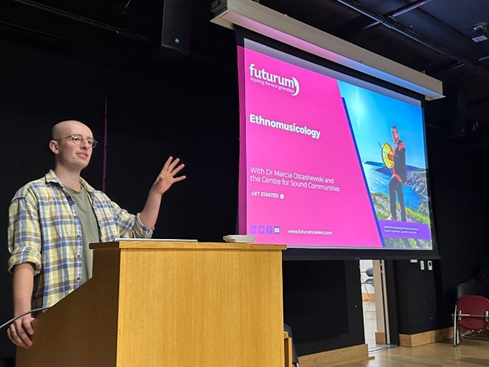
In September 2025, I was lucky enough to experience a taste of this diversity as Marcia invited me to present our resources at a course on world music pedagogy in Halifax, Nova Scotia. This course explored the role of music in teaching and learning through diverse cultural perspectives and in relationship with diverse local culture bearers and communities. While public speaking is not my favourite thing to do, I was excited to travel somewhere new and push myself out of my comfort zone.
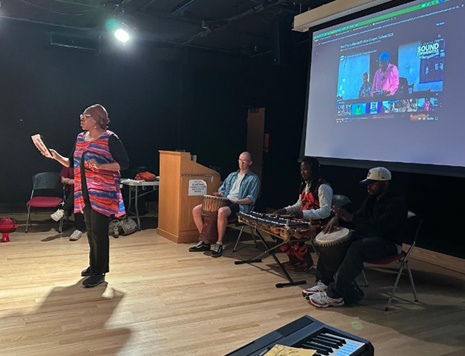
In the end, half an hour of sweaty palms and stammering speech was well worth it. Not only did I get to listen to Julian Kytasty, a world-renowned bandura player, but I also got to chat with him and learn about his musical heritage and traditions. Not only did I get to experience the joyful teaching of Mamadou Koita, a virtuoso balafón player from Burkina Faso, but I also got to play djembe alongside him and Afua Cooper, a slam poet, author and scholar.
I’ve been a drummer for the best part of two decades, but taking part in this course and working with Marcia has broadened my understanding of what music is, what it can be and what it can mean to different people. Music can be collaboration and friendship, culture and purpose, identity and belonging.
In Marcia’s podcast episode, I spoke to Leim Joe, a research assistant at the CSC who grew up in Eskasoni, the world’s largest Mi’kmaw First Nation community. I asked Leim about his relationship with Mi’kmaw music and how it shapes his identity. This is what he said:
“I’ve always been part of it. I’ve always heard the chants. But a couple years ago, somebody told me, “If you don’t take a hold of your culture now, you will regret it, because every time you look at somebody and you’re proud of them, but you’re not proud of yourself, you’re missing out.” So I picked up the drum and started singing.”
While it’s easy to think of music as something done by other people – performed by pop stars, played by musicians, studied by ethnomusicologists – the truth is that music is a part of all of us. No matter where you live or where you’re from, the chances are that music plays a role in your culture, whether you have “taken hold of it” yet or not. All that remains is for you to pick up the drum and start singing.
You can access the Centre for Sound Communities Futurum resources here: futurumcareers.com/how-can-innovative-ethnomusicology-research-help-foster-diversity-inclusivity-and-equity-in-the-music-industry
The post Exploring ethnomusicology with the Centre for Sound Communities appeared first on Futurum.
“}]]