

Can eye-tracking uncover the secrets of social media advertising?
[[{“value”:”
Can eye-tracking uncover the secrets of social media advertising?
The rise of social media has provided advertisers with new ways to connect with potential customers, by designing adverts that blend in with other social media content. At Hochschule Ruhr West University of Applied Sciences in Germany, behavioural scientists Dr Maike Hübner and Professor Julia Thalmann are using eye-tracking technology to examine how users engage with these ‘native ads’.
Talk like a behavioural scientist
Consumer literacy – the ability to make informed decisions as a consumer
Disclosure – a label to show that a social media post is sponsored content or advertising
Eye-tracking – the process of measuring, recording and analysing how a person looks at something (where, for how long and in what order)
Native ad – an advertisement designed to match the look and feel of surrounding content
Organic content – non-paid social media posts, such as content shared by users or brands without paying the social media platform or influencers
Sponsored content – social media posts that brands pay a social media platform or influencer to share, such as adverts
Adverts are always evolving in response to societal changes, as advertisers create new ways to attract people’s attention and encourage them to buy products. In recent years, social media has become a dominant influence in many people’s lives. “Originally, when social media sites were viewed on computer screens, ads were often placed in banners at the top or side of the screen,” says Dr Maike Hübner, a behavioural scientist at Hochschule Ruhr West University of Applied Sciences. “However, viewers learnt to ignore these areas – a behaviour called ‘banner blindness’.” And today, most people use social media on their phone, where screen space is much more limited.
These developments and behaviours made banner ads less effective, so advertisers needed new ways of getting users’ attention – and ‘native ads’ were born. “A native ad is an advertisement that looks like normal platform content,” says Maike. “Instead of appearing as a separate commercial, it is placed directly into a social media feed, so it blends in with posts from friends or influencers.”
Going native
Most people disengage from a social media post when they recognise it as advertising, which is why native ads try to blend in. “Brands have approximately 1.7 seconds to capture users’ attention before they scroll on,” says Maike. “Because native ads are designed to look similar to regular posts, they can be harder to recognise quickly, potentially allowing them to be processed more like regular content.”
However, native ads are not allowed to go fully in disguise. “If you cannot tell that something has commercial intent behind it, you cannot judge it critically,” explains Professor Julia Thalmann. “Clear labelling of sponsored content helps users make informed decisions.” This is why most countries have laws about advertising transparency which require native ads to include a disclosure – a label such as ‘sponsored’ or ‘ad’.
This creates what researchers refer to as the ‘disclosure dilemma’ – it is important that adverts are transparent so viewers know they are being advertised to, but when they realise they are being advertised to, they will often disengage. Maike and Julia wanted to disentangle the dynamics of the disclosure dilemma in native advertising.
Making an Insta-sham
Maike and Julia conducted an experiment to observe how viewers engaged with native ads. First, they created a mock Instagram feed containing 29 posts about common Instagram themes (e.g., travel, fashion, lifestyle). Eight of these posts were real native ads published by brands, and the remaining 21 were real organic posts.
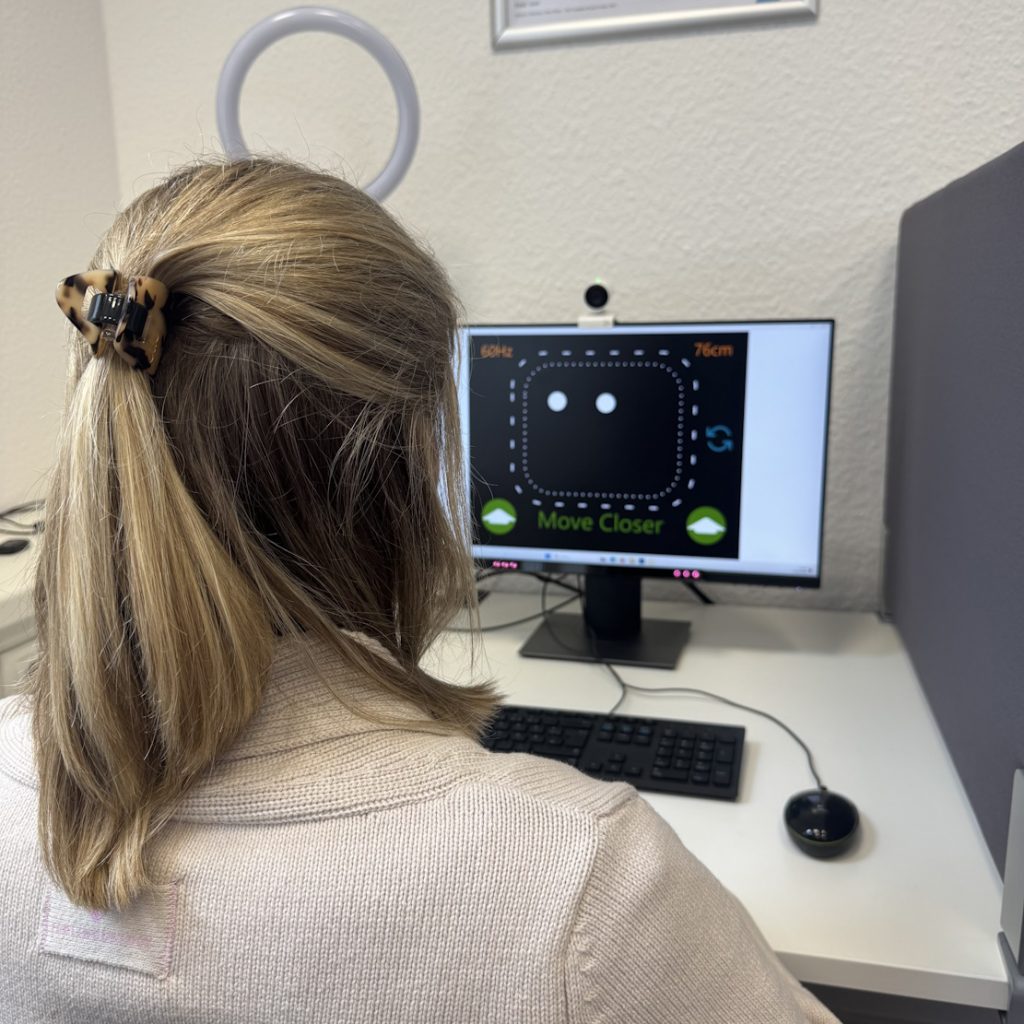
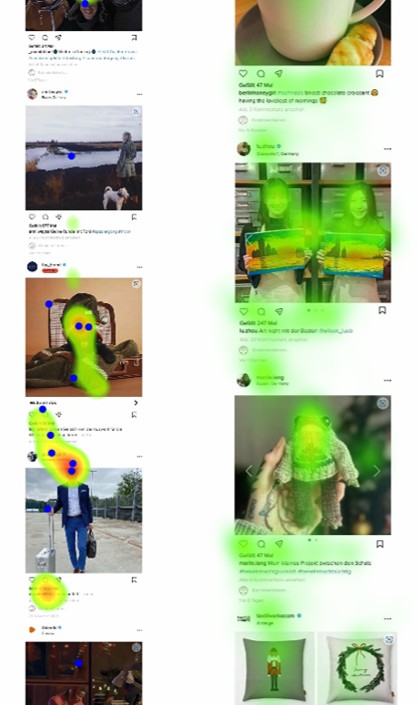
Then, participants were asked to scroll through the mock feed and interact with the posts naturally, as though this was their personal Instagram feed, while Maike and Julia recorded their gaze using eye-tracking technology. “Eye-tracking technology uses infrared light to track where a person is looking on a screen by detecting reflections from the eyes,” explains Julia.
Maike and Julia defined ‘areas of interest’ within Instagram posts, such as image, profile information, and ‘like’ and ‘share’ icons, plus advertising-specific elements such as disclosures and call-to-action buttons like ‘shop now’. “Using eye-tracking metrics, we could assess attention allocation on each area of interest, revealing which post elements attract users’ gaze, in which order, and for how long,” says Julia.
Maike interviewed the participants after they had scrolled through the mock Instagram feed and asked them to explain what they were thinking while they looked at each post and why they engaged with it or scrolled past. “Someone might skip a post because they recognise it as an ad, because it is not relevant to their interests, or simply because they are scrolling quickly,” says Maike. “Combining eye-tracking data with these interviews helped us understand both what people did and why they did it.”
Are you being influenced?
This combination of data led to some interesting findings. “People spent less time looking at sponsored posts than organic ones,” says Maike. “When they noticed a ‘sponsored’ label or call-to-action button, they usually stopped engaging with the post.” However, if they did not notice these cues, many people interacted with native ads in the same way as organic content. “In the interviews, several participants said they scroll so quickly that they rarely pay attention to disclosures,” says Maike. “This suggests that advertising can influence people even when they are not aware of it.”
This raises questions about whether current disclosure rules are sufficiently robust to help consumers easily recognise sponsored content. To design digital spaces that are both engaging and transparent, it is important to understand how viewers interact with native ads. “Our research shows that transparency and engagement are closely linked,” says Julia. “Advertisers can benefit from our findings by making adverts visually clear and honest rather than trying to blend in unnoticed, as transparency builds trust.”
Maike finishes with advice to help you develop your own consumer literacy: “Recognising ads is not just about spotting disclosures or call-to-action buttons, it’s also about asking questions,” she says. “Ask yourself, what is the intent behind this post? Is someone trying to sell me something, promote an idea or influence how I feel? And why do I like or want this? Is it genuinely useful, or am I just afraid of missing out? Consumer literacy is about staying curious and reflective. Taking a moment to question what you see and why you respond to it will give you more control over your decisions.”
Dr Maike Hübner
Research Associate
Fields of research: Behavioural science; advertising
Professor Julia Thalmann
Professor of Retail Management and E-Commerce
Fields of research: Retail marketing; consumer behaviour; user experience (UX)
Hochschule Ruhr West University of Applied Sciences, Germany
Research project: Using eye-tracking to investigate native ad engagement
Funders: Hochschule Ruhr West University of Applied Sciences; Fundação para a Ciência e a Tecnologia
Reference
https://doi.org/10.33424/FUTURUM687
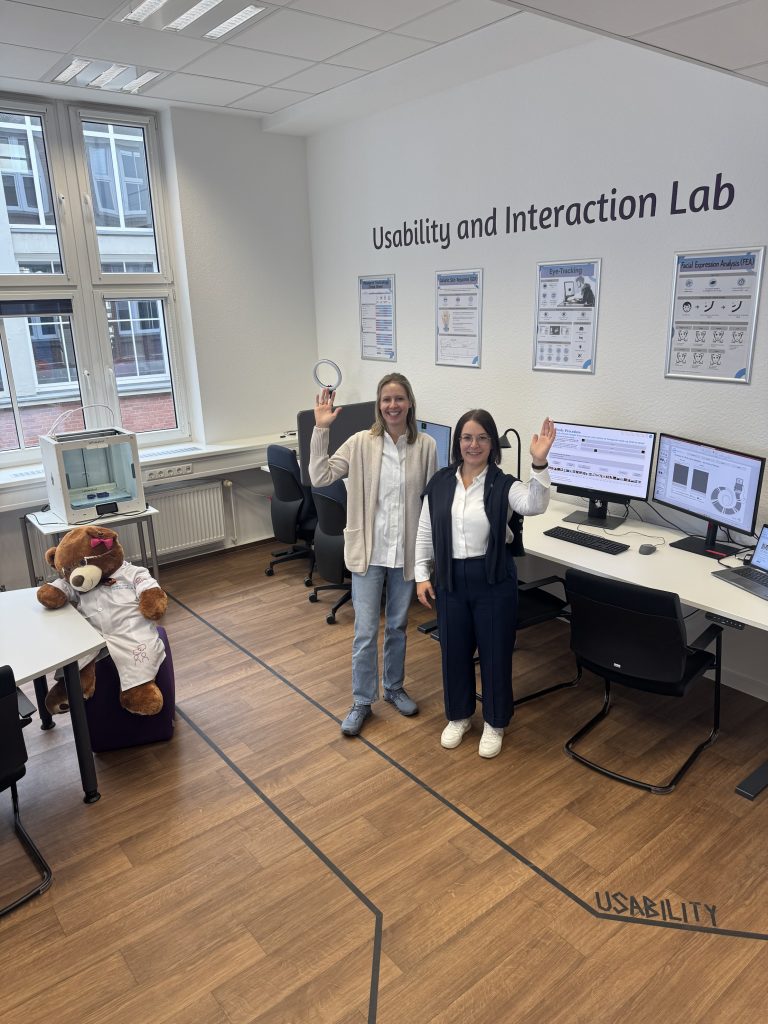


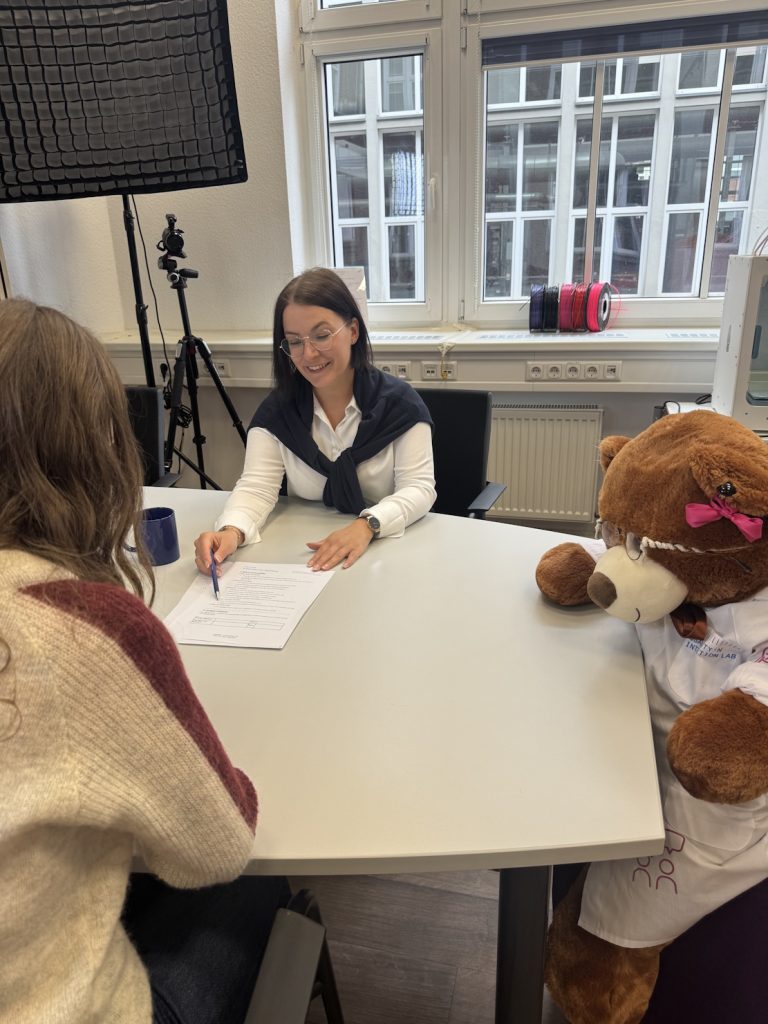

Betty Brown is Maike and Julia’s lab mascot! She represents the lab slogan: ‘Design with the user in mind because every detail bears meaning.’
All images © Uni Lab, HRW

About behavioural science
Behavioural science is the scientific study of human behaviour, combining insights from fields such as psychology, sociology, neuroscience and economics. “Behavioural science helps us understand how people make decisions in real life,” says Maike. “It is important that businesses understand consumer behaviour, because they often assume people make rational choices, but in reality, many decisions are made quickly and are based on habits or emotions.”
Common lines of behavioural science research involve investigating how attention, perception and decision-making work – areas that are of high interest to advertising companies working out how to sell products. “Behavioural science is also important for consumer protection,” says Maike. “It helps us identify when people may be misled or overwhelmed by information and how to support better decision-making.”
Behavioural science is always evolving because the factors that affect our behaviour are always changing, especially technology. “Things like voice assistants, social robots and AI tools are being designed to seem more human,” says Julia. “Behavioural scientists will study how people interact with these human-like technologies.” Additionally, virtual reality is blurring the lines between physical and virtual interaction and opening the door for new forms of advertising, such as adverts being displayed within the virtual environments of computer games. These topics are all highly interesting and important to behavioural scientists as they help us navigate this new world.
Pathway from school to behavioural science
“Behavioural science connects many fields, so combining different perspectives will help you understand how people behave and how systems, products and markets work,” says Julia.
Subjects such as psychology and sociology will teach you about how people think, feel and behave, while business and marketing will teach you how organisations make decisions and how behaviour is studied in real-world settings.
Learn statistics and data analysis skills as these are very important for analysing research data.
“Stay curious about how people think and behave,” advises Maike. “And develop creativity and communication skills. Behavioural scientists work in teams across different disciplines, so being open-minded and collaborative is important.”
Explore careers in behavioural science
Behavioural scientists understand human behaviour and decision-making, so are sought after in many different fields and industries. For example, you could work in advertising or marketing to persuade people to buy products, for a tech company to ensure that new technological innovations are user-friendly, for a political organisation to understand why people support different political parties, or for a healthcare organisation to encourage people to adopt healthier lifestyles.
This article introduces you to different career paths in behavioural science: thedecisionlab.com/insights/hr/a-guide-to-career-paths-in-behavioral-science
Meet Maike
 I’ve always been curious about why people do what they do. When I was at school, I also enjoyed creative subjects, and anything that let me question things and start a good debate.
Over time, I realised I was always the person asking “Why?” Why do people follow trends? Why do we trust certain messages? Why do people change their behaviour? When I discovered that the field of behavioural science is dedicated to studying exactly that, it felt like a natural fit.
I was motivated to study native ad engagement when I started noticing how often people around me referred to social media when talking about their decisions. Friends and family would say things like, “Someone I follow recommended this,” or “This influencer uses that, so I tried it too.” I found it fascinating and a bit strange how much trust people place in someone they have never met. I wanted to understand how this influence works and if these people fully realise they are being persuaded.
I spend much of my free time in my garden. I enjoy planting, harvesting and cooking with what grows there. I also love meeting friends to play board games and card games. And I will never say no to visiting a petting zoo and booping animal noses!
Maike’s top tips
1. Embrace being the person who asks questions, especially when others might hesitate.
2. If something feels strange, unclear, or overly persuasive, take a step back and try to understand the underlying reasons.
3. Remember that it’s okay to be different, to challenge ideas, and to question the status quo.
Meet Julia
 As a teenager, I was fascinated by branding and retail advertising, and I was curious about how businesses work behind-the-scenes. At the same time, I wanted to explore the world and experience new cultures.
I spent several years working in the marketing industry. At the manufacturing company Henkel, I worked in sales, brand management and marketing, and later at the pharmaceutical company Johnson & Johnson, I managed retail accounts and commercial planning. These roles gave me a strong understanding of how consumer psychology, retail structures and strategic decision-making interact.
I actively use social media across various platforms, both professionally and personally. I am mindful about the content I consume and the time I spend online. Given my academic focus, I am very aware of how algorithms, recommendation systems and profiling mechanisms operate.
I recharge the most when spending time with family and close friends. I enjoy exploring new things – from trying out new recipes to travelling somewhere unfamiliar. Being active outdoors, especially hiking, skiing or running, gives me energy and perspective.
Julia’s top tips
1. Never stop learning. AI, digital platforms and consumer research are evolving rapidly, so continuous learning is essential.
2. Go international because living and working abroad builds perspectives and adaptability that last a lifetime.
3. Take responsibility. Leadership grows through experience, so step into projects that challenge you.
Do you have a question for Maike of Julia?
Write it in the comments box below and he will get back to you. (Remember, researchers are very busy people, so you may have to wait a few days.)
Discover how behavioural scientists are exploring the link between diversity in the workplace and productivity:
futurumcareers.com/why-is-diversity-important-for-productivity
The post Can eye-tracking uncover the secrets of social media advertising? appeared first on Futurum.
“}]]