
Newton Disc Explained: Does It Really Turn Colors White?
[[{“value”:”
You searched for a clear Newton Disc explained, so let’s make this simple and undeniable.
You have probably seen a Newton Disc spin before.
It looks like a cheap toy at first glance.
Colored slices blur into white as it spins fast.
Most people shrug and move on.
But something deeper is happening right in front of you.
Let’s test that idea together.
The Most Skeptical Person About the Newton Disc Experiment
Picture someone rolling their eyes at science demos.
They think simple experiments are tricks, not real proof.
They say things like, “That’s just an illusion.”
They believe real science must be complex and hard.
They distrust anything that looks too easy or obvious.
They assume color mixing should always follow paint rules.
They think spinning colors into white sounds wrong.
They believe white is “pure,” not a mix of colors.
They expect hidden tricks or lighting effects.
They feel confident nothing new will surprise them.
That is the person we are speaking to now.
Maybe that person is you.
What Happens When You Mix Paint Colors?
Think about mixing red, blue, and yellow paint.
You get brown or a muddy dark color.
It never turns into clean white.
So your brain builds a rule from that.
Mixing colors makes things darker, not lighter.
That feels true from everyday experience.
But is paint the only way colors can mix?
What If Light Behaves Differently Than Paint Mixing?
Paint absorbs light.
That means it removes parts of what you see.
Each color takes away something from the light.
More mixing means more light removed.
That is why paint gets darker.
But what if you deal with light itself?
Light adds instead of subtracts.
Could mixing light give a different result?
What Colors Exist Inside White Light Spectrum?
Think about sunlight after rain.
You see a rainbow stretch across the sky.
That rainbow splits white light into many colors.
Red, orange, yellow, green, blue, and violet appear clearly.
So white light already holds all these colors inside.
It is not empty or pure in a simple way.
It is a mix of many wavelengths together.
If that is true, what happens when you combine them again?
Can Separate Colors Rebuild White Light?
Imagine reversing a rainbow.
Take each color and stack them back together.
Would you get white again?
If white already contains all those colors, it makes sense.
You are just putting the pieces back together.
So the idea is not strange anymore.
It follows a simple logic.
But how do you test it easily?
What Does a Newton Disc Do to Show Color Mixing?
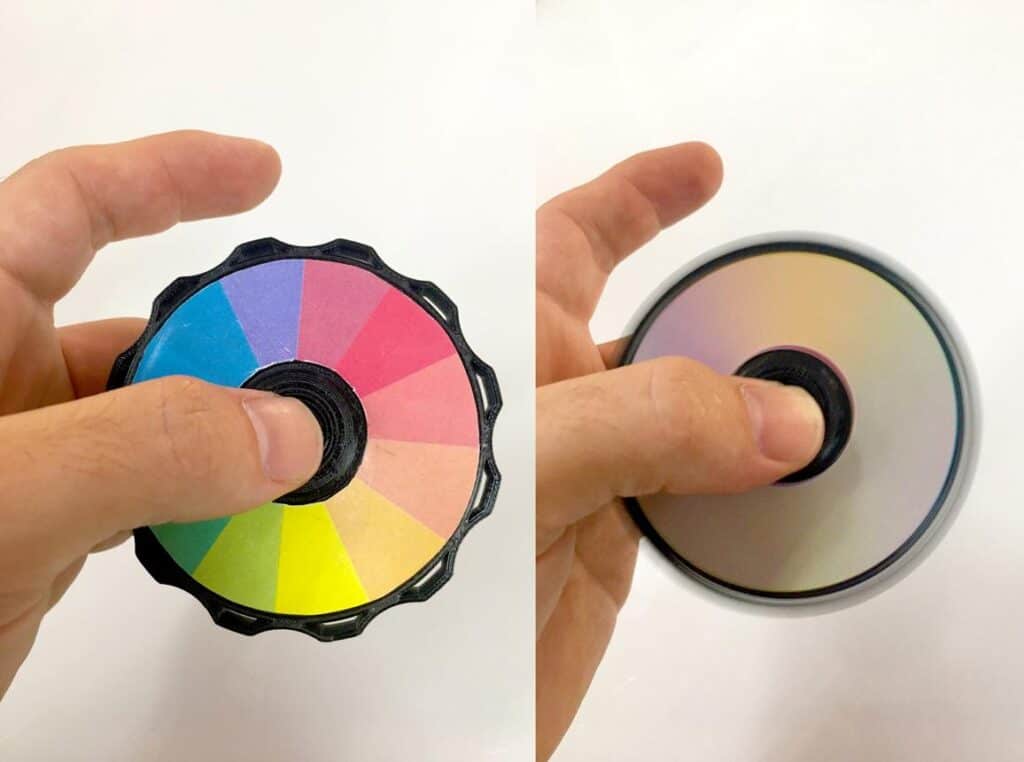
The Isaac Newton Disc uses colored slices.
Each slice represents part of the spectrum.
When the disc is still, you see clear segments.
Red sits next to orange, then yellow, then others.
Nothing surprising so far.
But when you spin it fast, something changes.
The colors blur together into one.
That one color looks white or pale grey.
Why does your eye see that instead of rainbow stripes?
What is the Newton Disc and how does it work?
The Newton Disc is a spinning disc with rainbow colors.
When it spins fast, your eyes blend the colors together.
This creates the appearance of white light.
It works because your brain combines light signals quickly.
How Fast Does Your Eye Process Color Changes?
Your eyes do not see each moment separately.
They blend quick changes into one smooth image.
This effect is called persistence of vision.
It is why movies look like motion, not still frames.
The disc spins faster than your brain can separate colors.
So your brain averages the colors together.
It merges them into one combined signal.
What would that combined signal represent?
What Happens When All Light Colors Hit Your Eye Together?
Each color sends a different signal to your eye.
Red, green, and blue are the main signals your brain uses.
When all signals arrive together, your brain reads “white.”
That is how screens create white pixels.
They mix red, green, and blue light.
So the disc is doing something similar.
It feeds your eye all colors at once.
Your brain combines them into white.
Does that still feel like a trick, or something logical?
Is the Newton Disc Just a Lighting Illusion?
Maybe you think lighting is fooling you.
That is a fair question.
But the effect works in normal daylight.
It works under indoor lights too.
It works with different discs and setups.
The result stays consistent.
If it were a trick, results would change often.
But they do not.
What does that say about the reliability of the effect?
Why Doesn’t the Newton Disc Turn Pure White?
You might notice the white looks slightly grey.
That can feel like a flaw in the idea.
But look closer at the disc itself.
The colors printed are not perfect light sources.
They are pigments, not pure light wavelengths.
Some light still gets absorbed.
That makes the final color slightly dull.
But the trend still holds true.
The colors move toward white when combined.
Is that enough evidence to support the idea?
What Does the Newton Disc Teach About Color Perception?
Step back and think about what you just reasoned.
Paint mixing removes light and darkens results.
Light mixing adds signals and brightens results.
White light contains many colors already.
Combining those colors recreates white.
Your eyes blend fast signals into one perception.
The Newton Disc simply uses that fact.
So what is color, really?
Is it a fixed property, or something your brain builds?
What You Just Discovered About How the Newton Disc Works
You did not get handed a conclusion.
You built it step by step yourself.
Each answer led naturally to the next.
No leap of faith was required.
No hidden trick was needed.
The Newton Disc stopped looking like a toy.
It became a clear demonstration of how light works.
Why the Newton Disc Experiment Matters in Real Life
This simple disc shows a bigger truth.
Your senses do not show raw reality.
They build a version your brain understands.
Color is not “out there” in objects alone.
It exists in how your brain processes light.
That idea connects to screens, cameras, and art.
It shapes how we design everything visual.
From phones to movies to paintings.
All of it depends on how we mix light.
In fact, modern displays use the same principle.
Every screen mixes red, green, and blue light to form white.
That is the same idea behind the Newton Disc experiment.
Try the Newton Disc Experiment Yourself at Home
You do not need a lab to test this.
I have made this disc myself using cardboard and markers.
You can make one in minutes.
Draw colored slices on cardboard.
Attach it to a pencil or spinner.
Spin it as fast as you can.
Watch the colors blend into white.
Seeing it yourself changes everything.
The Real Takeaway About the Newton Disc
You started with doubt, and that was fair.
Simple things often feel too easy to trust.
But the strongest ideas are often the simplest ones.
They hold up under clear, honest questions.
The Newton Disc explained one thing clearly.
Light mixes differently than paint, and your brain proves it.
Now stop guessing and test it yourself.
“}]]