
How can psychologists generate more realistic avatars for virtual reality experiments?
[[{“value”:”
How can psychologists generate more realistic avatars for virtual reality experiments?
Virtual reality is a useful tool for a range of research areas, from perception to therapeutic interventions, where avatars can be used as substitutes for real people in virtual experiments. However, while virtual reality video games often contain lifelike avatars, academic researchers do not have the technology, money or animation expertise to create avatars that look and behave like real people, which limits their usefulness. To address this problem, Dr Rachael Taylor, a behavioural psychologist at the University of Kent in the UK, has developed an accessible method for constructing realistic avatars.
Talk like a behavioural psychologist
Avatar – a computer-generated representation of a person
Blend shape – a deformation of a 3D model
Social presence – the sense of being in the presence of another person
Social signal – a behaviour used to communicate, such as a facial expression or body language
Virtual reality – a computer-generated environment that someone can enter, usually by wearing a virtual reality headset
Have you ever worn a virtual reality headset and entered a computer-generated world to race cars, fight dragons or kill zombies? Virtual reality (also known as VR) allows players to immerse themselves in simulated environments, so they feel truly present in a game.
But virtual reality has many uses beyond entertainment. Psychologists are increasingly conducting experiments in virtual reality because it allows them to create controlled immersive environments to observe how people behave in different situations. For example, by placing participants in virtual rooms with avatars, psychologists can explore how people react to social signals such as gestures and body language. And virtual reality can be used for therapy by exposing patients to immersive experiences while keeping them in a safe space.
“I use virtual reality to investigate how people interpret an avatar’s social signals, such as facial expression and eye gaze,” says Dr Rachael Taylor, a behavioural psychologist at the University of Kent. “Avatars have the potential to be useful research tools because they can be programmed to display consistent behaviours, allowing for standardisation between different participants during experiments.”
However, it is challenging to create computer-generated avatars that look and behave like real humans, which limits how useful these virtual experiments can be. “Previous research has shown that a person’s sense of social presence towards an avatar is influenced by how well the avatar’s appearance and behaviour compare to that of a real person,” Rachael continues. “Therefore, creating realistic avatars that can display social signals is an important step in improving their use for future research.”
How can psychologists create realistic avatars?
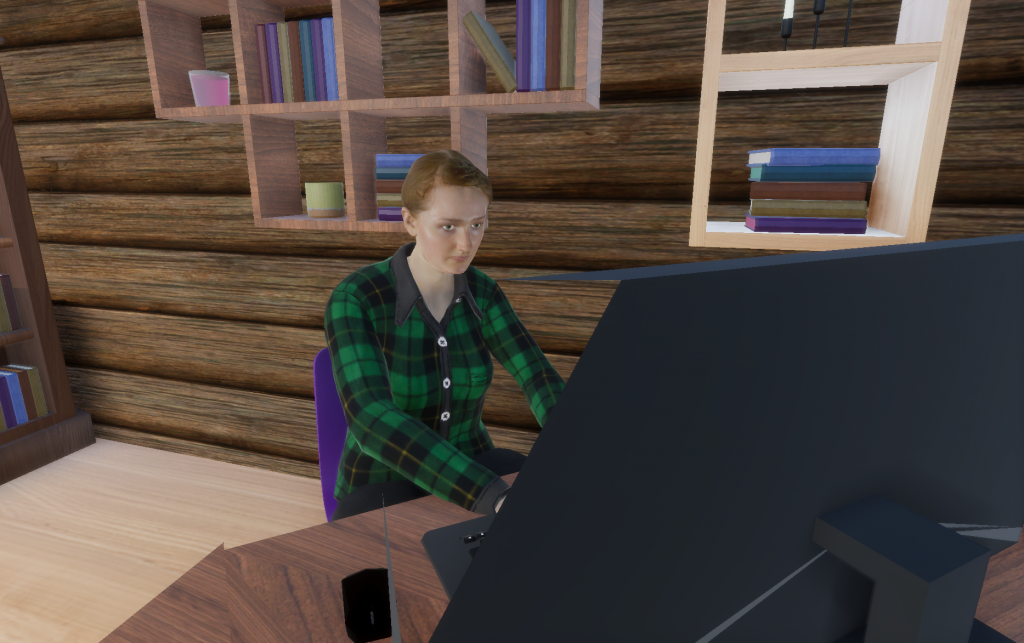
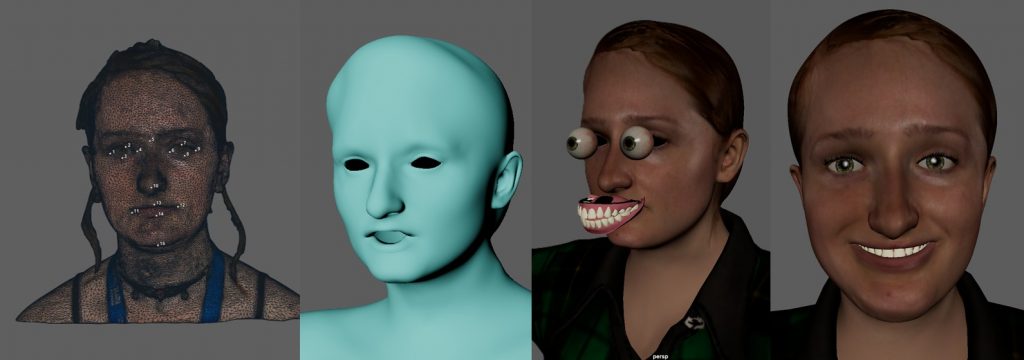
The research team in the School of Psychology at the University of Kent has developed a method that other psychologists can use to create more realistic avatars for their virtual reality experiments. The first step involves using a 3D scanner to take many photos of a real person’s head from different angles, capturing both the shape of their face and the texture of their skin and hair. Scanning software can combine the photos to create a visually accurate digital 3D model of the person’s head.
Then, having created an avatar head with a realistic appearance, the next step is to give it realistic behaviour. “To do this, you need to create eye and mouth sockets in the 3D model of the face, so you can insert moveable eyes and teeth,” Rachael explains. “You also need to create blend shapes, which are deformations in the 3D model that reflect movement of different parts of the face, such as an eyebrow raise.” By combining different blend shapes, psychologists can give their avatars different facial expressions. Finally, they can connect their realistic avatar head to a virtual avatar body created using free character creator software.
Reference
https://doi.org/10.33424/FUTURUM705
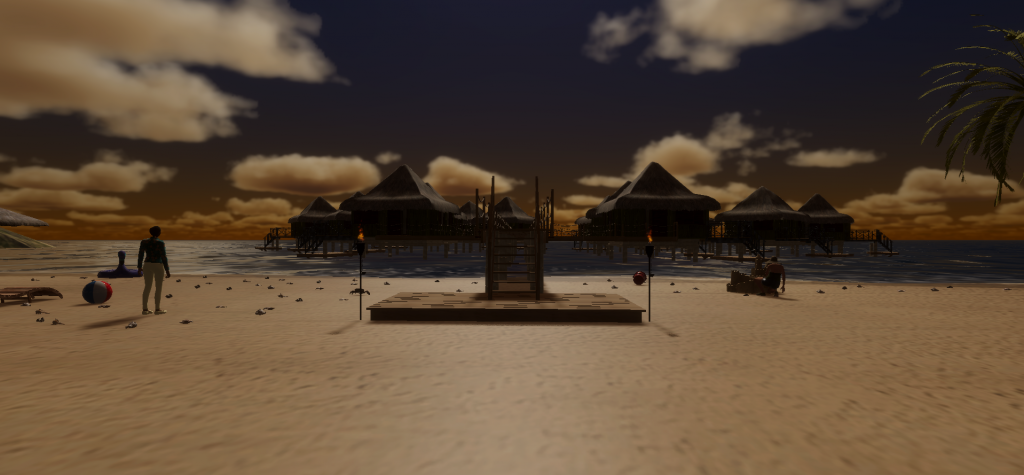
An example of a virtual reality environment.
All images © Rachael Taylor


How realistic are Rachael’s avatars?
For this avatar creation method to be useful for psychology experiments, people need to respond to the avatars it produces in the same way as they would respond to humans. To test whether this is the case, Rachael and the team conducted their own virtual reality experiments to see how people react to the avatars’ eye gaze and facial expressions.
You are more likely to process the properties of an object, such as its location or colour, if you see someone else looking at it – a phenomenon known as the gaze-cueing effect. Rachael tested whether her avatars produced the gaze-cueing effect by placing participants in a virtual room with an avatar, who would gaze towards the left or right before a white sphere appeared in the room. Participants had to identify the location of the sphere as quickly and accurately as possible. The team found that the spheres were indeed located more quickly when the avatar gazed towards (rather than away from) its location before it appeared, demonstrating human-like gaze-cueing effects.
To see how participants recognise avatar facial expressions, the avatars were also animated to display the emotions of happiness, sadness, anger, fear, surprise and disgust. When participants were placed in a virtual room with these avatars, they were generally accurate at recognising their facial expressions.
“Our findings demonstrate the validity of our avatars as research tools and show they have good potential for exploring how people process social signals in virtual reality experiments,” Rachael concludes. “Our avatars produce a strong gaze-cueing effect and are also capable of displaying complex facial expressions.”
How is Rachael’s research helping psychologists?
“By developing our avatar construction method, our goal is to empower researchers who are inexperienced with creating avatars to be able to generate realistic avatars for their virtual reality experiments,” says Rachael. This method for creating realistic avatars does not require expensive equipment, specialist software or animation expertise meaning it is accessible for all psychology researchers.
“In addition to developing the avatar construction technique, I have also written a detailed guide for researchers who are interested in using virtual reality in their experiments but don’t know where to begin,” says Rachael. Through this work, Rachael and the team at the University of Kent hope to advance the wider fields of psychology and behavioural science by teaching other researchers how to create immersive virtual reality experiments containing realistic avatars.
 Dr Rachael Taylor
School of Psychology, University of Kent, UK
Field of research: Behavioural psychology
Research paper: High-Fidelity Avatars for Behaviour and Cognition Research in Virtual Environments: An Accessible Construction Method for Scientists. Taylor, R. L., et al (in press)
Funder: Rachael Taylor’s work is funded by a research grant from the Economic and Social Research Council (ESRC Grant no ES/X011208/1) to Markus Bindemann at University of Kent and Mike Burton at the University of York.
Do you have a question for Rachael?
Write it in the comments box below and she will get back to you. (Remember, researchers are very busy people, so you may have to wait a few days.)
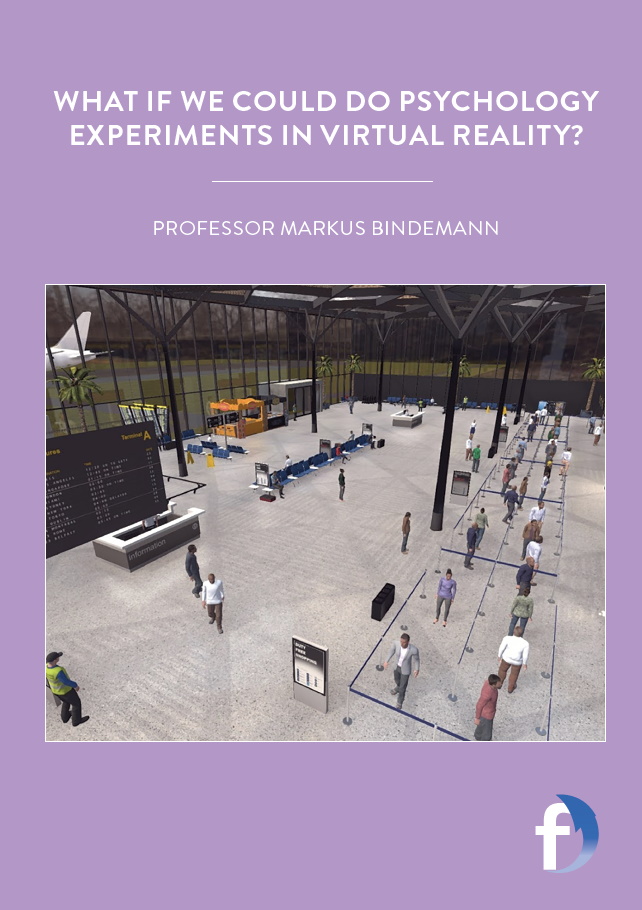
Learn how Rachael’s colleague, Professor Markus Bindemann, is using realistic avatars to study face perception:
futurumcareers.com/what-if-we-could-do-psychology-experiments-in-virtual-reality
The post How can psychologists generate more realistic avatars for virtual reality experiments? appeared first on Futurum.
“}]]