
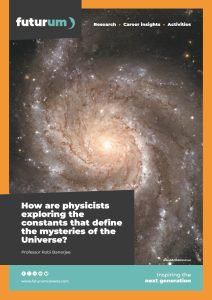
How are physicists exploring the constants that define the mysteries of the Universe?
[[{“value”:”
How are physicists exploring the constants that define the mysteries of the Universe?
The interactions between light and matter are a fundamental part of nature. Physicists have discovered that these interactions can be defined by a constant with the value of ~1/137, but as yet, no one knows why. As an astrophysicist at the University of Hamburg in Germany, Professor Robi Banerjee is exploring how the fundamental constants and dimensions give rise to this mysterious number.
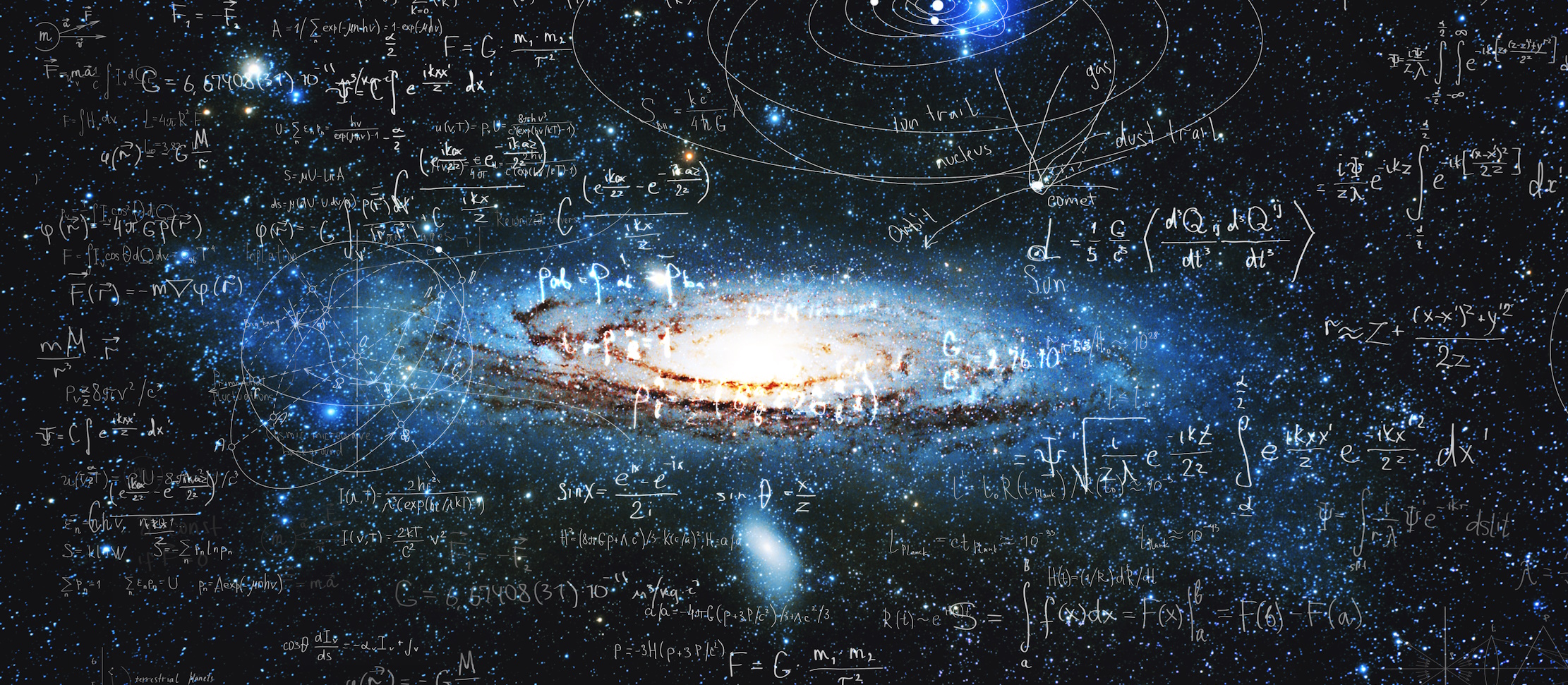
The fine-structure constant is responsible for the light we see,
even for the light from stars in distant galaxies.
@Lia Koltyrina/Shutterstock.com
 Talk like an …astrophysicist
Constant – a value that does not change
Dimension – a measurable aspect of a physical system
Dimensional analysis – a mathematical method to check the dimensions of a system
Elementary charge (e) – the charge on an electron (1.6 × 10⁻¹⁹ coulombs)
Fine-structure constant (α) – a dimensionless number related to the interaction between photons and electrons (~1/137)
Gravitational constant (G) – the strength of a gravitational field exerted by a mass (6.7 × 10⁻¹¹ m3·kg-1·s-2)
Planck’s constant (h) – a constant related to the energy of a photon (6.6 × 10⁻³⁴ m2·kg·s-1)
Photon – a quantum particle of light
Quantum mechanics – the branch of physics that describes how light and matter behave at the subatomic level
Reduced Planck’s constant (ħ) – ħ = h/2π
Speed of light (c) – the speed of photons in a vacuum (~3.0 × 10⁸ m·s-1)

Professor Robi Banerjee
Department of Physics, Hamburg Observatory, University of Hamburg, Germany
Fields of research: Astrophysics; theoretical physics
Research project: Using dimensional analysis to explore the links between the fundamental constants and dimensions and the fine-structure constant
Funder: University of Hamburg
DOI: doi.org/10.33424/FUTURUM742
For centuries, humans have attempted to uncover the mysteries of the Universe. And while physics can describe how nature works, many questions still remain. “It is hard to believe that we can understand nature, given its complexity,” says Professor Robi Banerjee, an astrophysicist at the University of Hamburg. “But we can describe nature with the laws of physics, using the language of mathematics. Everything breaks down into a few simple laws and constants, and this is a mystery in itself!”
As far as we know, these laws and constants are unchanging throughout time and space. Physicists have tried to find places in the Universe where these laws and constants do not hold true or have altered over time. “But so far, there are no hints that these fundamental concepts are changing,” says Robi. “To me, this is an unexplained miracle!”
What are the fundamental constants and dimensions?
You have probably heard of some famous physics laws which describe the world around us, such as Newton’s laws of motion which describe how forces acting on an object will affect its motion, or Schrödinger’s equation which underpins the field of quantum mechanics. And you might be aware of some constants in physics, such as the speed of light (c), the gravitational constant (G), elementary charge (e) and Planck’s constant (h).
“The physical world is a world which can be measured, and to do so, we need units,” says Robi. For example, velocity is measured using the dimensions of length and time (giving units such as metres per second and miles per hour). “To map the complex world, we need only three dimensions – usually length, time and mass (while there are seven standard scientific units, these can all be derived from length, time and mass).”
Robi calls these four constants (c, G, e and h) and three dimensions (length, time and mass) the fundamental constants and dimensions. He was intrigued that while nature could be described by four constants, it only needed three dimensions. “Maybe one constant is redundant,” he thought. And so, he used a technique called dimensional analysis to link the four fundamental constants to the three fundamental dimensions to try to discover which constant did not combine with the others.
What is dimensional analysis?
“Dimensional analysis is a handy tool used in theoretical physics to quickly calculate answers about a system – as a physicist, I use it every day!” says Robi. “Dimensional analysis uses simple mathematical equations to calculate things like the energy in a system or its evolution over time. You don’t need to know much about your system, but it will give you a rough idea of quantities in your system which you can then analyse further with more precise calculations.”
A key aspect of dimensional analysis is that it allows physicists to explore the relationships between different dimensions within the system they are studying and check that the dimensions they are using are correct. “Through my dimensional analysis of the fundamental constants and dimensions, I showed that gravity is separate from the other constants,” says Robi. This finding can be applied to the fine-structure constant (α), which connects c, e and ħ (the reduced Planck’s constant), but not G.
What is the fine-structure constant?
“The fine-structure constant is a dimensionless constant which relates to the strength of interaction between photons and electrons,” explains Robi. “Consequently, it appears wherever light meets matter.” The fine-structure constant is therefore an important constant in physics. It defines the structure of atoms and forms the foundations of quantum mechanics. “If its value were even slightly different, atoms could not stably exist and life as we know it would be impossible,” says Robi.
The fine-structure constant has the equation α = e2/ħc and the value of ~1/137. But the question that has been puzzling physicists for generations is ‘Why?’. Where does this value of ~1/137 come from? “The odd and yet unexplained value of ~1/137 has driven many physicists mad!” says Robi. Austrian physicist and pioneer of quantum mechanics Wolfgang Pauli famously said, “When I die, my first question to the Devil will be ‘What is the meaning of the fine-structure constant?’”
The fact that the gravitational constant is not included in the fine-structure constant reflects the fact that gravity cannot be combined with quantum mechanics (at least to our current knowledge). “Through my dimensional analysis, I have not solved the mystery of why the fine-structure constant’s value is ~1/137, but I have shown that the fundamental constants and the fundamental dimensions are linked, excluding gravity which plays an unexplained separate role.”
Where can curiosity lead?
It was Robi’s curiosity about the mysteries of the Universe that led him to explore the fine-structure constant. “It is never too early to think about the fundamental problems of nature,” he says. Get excited by questions about how physics and mathematics explain the world around you. Where does the value of the fine-structure constant come from? Why can’t gravity be combined with the other fundamental constants? “While the solutions to these problems might not immediately have direct applications (though you never know), it is important to follow your curiosity,” emphasises Robi. What questions do you have about how the world works? Where will your curiosity lead you?



About astrophysics
“In astronomy (the study of space), experimental physicists are known as astronomers while theoretical physicists are known as astrophysicists,” explains Robi. “Astronomers do experiments and make astronomical observations with telescopes, while astrophysicists do calculations and perform computer simulations to predict the outcomes of physical systems which cannot be done in a laboratory.”
Astrophysicists use mathematics and computer models to try to uncover the mysteries of the Universe. They study topics such as how stars and galaxies form, what happens at black holes, and what the early Universe was like. Some astrophysicists work with engineers to design new telescopes to look deeper into space, while others work with astronomers to interpret the data collected from these telescopes.
“As physicists, it is our job to describe nature using maths,” says Robi. “I think it is a miracle that everything boils down to a few simple laws of physics.” Understanding the mystery of the fine-structure constant will have important implications for astrophysics, as it applies throughout the Universe wherever light interacts with matter. This means the next generation of astrophysicists will have plenty to work on – first to uncover why the value of the fine-structure constant is ~1/137 and then to explore how this can expand our knowledge of the Universe.
Pathway from school to astrophysics
At high school, study physics and mathematics, which will introduce you to the foundations needed to understand astrophysics. It would also be useful to learn computer coding as most physics work relies on computer models.
Take part in the International Olympiad on Astronomy and Astrophysics (ioaastrophysics.org) or the International Astronomy and Astrophysics Competition (iaac.space) to gain hands-on experience in space-related research and activities.
At university, study a degree in physics or astrophysics. To become a researcher, you will then need to gain a PhD in the field.
Develop your curiosity, as this is key for being an astrophysicist. “Physicists enjoy solving problems, have an affinity for mathematics and are patient,” says Robi.
Explore careers in astrophysics
Most astrophysicists work as researchers at universities or space observatories where, alongside teaching the next generation of astrophysicists, they use mathematics and computer models to explore the secrets of the Universe.
The Hamburg Observatory, where Robi works, is open to the public and organises educational activities, including school visits, public lectures and the chance to observe the night sky through the observatory’s telescopes: www.physik.uni-hamburg.de/hs/subsite—open-observatory.html
NASA provides a wealth of resources about astrophysics and careers in the field: science.nasa.gov/astrophysics
Meet Robi
As a teenager, I was very interested in computers and programming. This was in the 80’s, when PCs were just beginning. I also enjoyed playing sports and hanging out with friends.
After high school, I did an apprenticeship as a programmer. I then wanted to study electronics, but I also enrolled to study physics, just due to a gut feeling. Although places on the physics course were limited, I was accepted. It turned out that deciding to study physics was the best decision of my life! Right at the beginning of my studies, I fell in love with physics, especially the theoretical approach.
In the future, I hope to spend more time thinking about the limits of physics. I want to address questions such as ‘Why can nature be captured by a few simple physical laws?’ and ‘Is mathematics the language of nature? If so, does this mean mathematics is independent of humans?’
When I’m not working, I enjoy outdoor activities such as hiking and cycle racing. I am engaged in renewable energies and I also like programming and handcraft electronics.
Robi’s top tip
1. Don’t try to follow in other people’s footsteps. Instead, follow your own intuition.
2. Ask questions and pursue them until you find answers. Bother your teachers and other educated people!


Do you have a question for Robi?
Write it in the comments box below and he will get back to you. (Remember, researchers are very busy people, so you may have to wait a few days.)
Related article

Discover how astrophysicists are using quantum mechanics to study black holes:
futurumcareers.com/black-holes-the-meeting-of-gravity-and-quantum-physics
The post How are physicists exploring the constants that define the mysteries of the Universe? appeared first on Futurum.
“}]]