
How can we make paper mills more sustainable and efficient?
[[{“value”:”
How can we make paper mills more sustainable and efficient?
Paper mills are incredible machines that churn out thousands of tonnes of paper every single day. Despite this output, engineers are constantly looking for new ways to improve the paper production process. Working in collaboration with Veolia and Holmen Paper at RISE Research Institutes of Sweden, Luis Carlos Felix Tapia is part of a team that has developed a new process for treating and recycling wastewater in paper mills to make them more efficient, sustainable and cost effective. The original concept and project were conceived by Luis Fernando Delgado Zambrano, a former researcher at RISE.
Talk like a chemical engineer
Aerobic — an organism that requires oxygen to survive
Anaerobic — an organism that does not require oxygen to survive
Cellulose — the primary structural component of plant cell walls
Paper mill — a factory that produces paper
Have you ever wondered how paper is made? First, logs are chopped into tiny woodchips, which are then cooked in hot water and chemicals. This process turns the chips into a watery, mushy pulp made of cellulose fibres. The pulp is then cleaned to remove the chemicals and diluted with lots of water to create a mixture that is 99% water and 1% cellulose fibre.
This mixture is then sprayed onto a fast-moving mesh screen and, as the screen moves, the water drains through the mesh, leaving behind a huge, soggy sheet of cellulose fibres. The sheet is then squeezed through hot, metal rollers which press out any remaining moisture and smooth out the surface. When the sheet is fully dry, it is cut into smaller sheets to make paper.
All of this takes place inside giant, complex machines that have been carefully designed to be as productive as possible. Even so, engineers are constantly figuring out new ways to improve these paper mills and make the process more efficient, cost effective and sustainable. For example, A team led by RISE Research Institutes of Sweden – including research and development engineer Luis Carlos Felix Tapia – together with Veolia and Holmen Paper, have developed a new method for treating and recycling wastewater from papermaking. Originally conceived by Luis Fernando Delgado Zambrano, formerly at RISE, the project aims to improve the efficiency and sustainability of the Swedish pulp and paper industry.
Reusing water
The process of making paper requires an immense amount of water, which is used to dilute the pulp and clean off the chemicals. So, rather than sucking fresh water in from the surrounding environment and dumping wastewater back out, paper mills use a closed water-circulation system to recycle process water. In fact, up to 95% of the water used in these machines is recaptured, treated and pumped back to the start of the system.
Although these closed systems make the paper mills much more sustainable and environmentally friendly, reusing water can affect the efficiency of the process and the quality of the final product. “In paper mills, water is used to transport both the cellulose fibres and the chemical additives,” explains Luis. “Unfortunately, this leads to an increased amount of chemicals and unremoved contaminants flowing around the machine.” This issue is even more prominent in recycled paper mills where contaminants from the recycled paper are also released into the water stream.
Treating wastewater
Reference
https://doi.org/10.33424/FUTURUM730
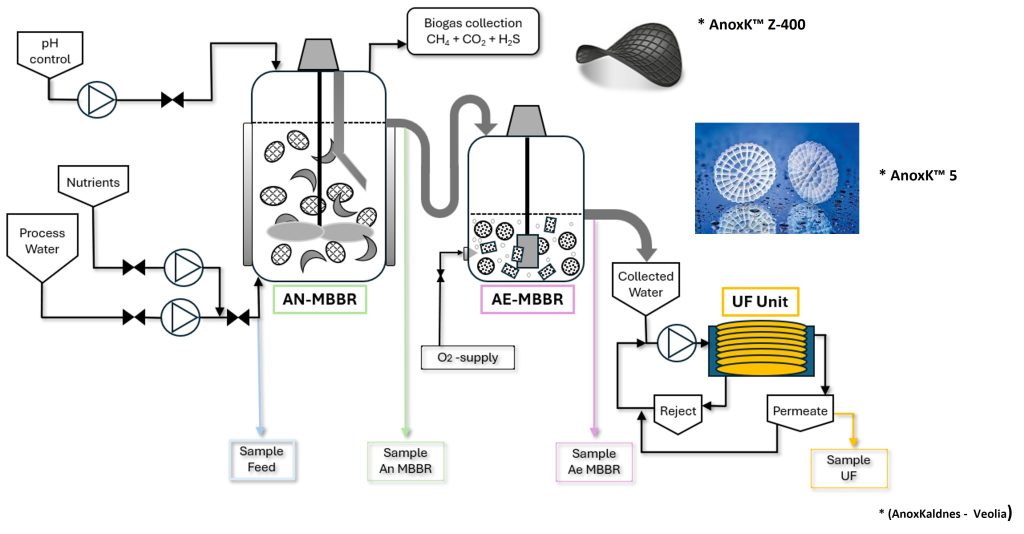






Before they can reuse this contaminated water, paper mills must treat it to remove chemicals and dissolved organic materials. “Normally, this is achieved through a combination of mechanical treatment followed by biological treatments,” says Luis. Mechanical treatments remove solid waste, such as large particles, sand or fragments of plastic, by passing the water through screens, allowing sediments to settle to the bottom of large tanks, less using microscopic bubbles to capture stray wood fibres and float them to the surface.
Biological treatments remove organic substances, such as dissolved wood sugars (starch) and complex wood resins, by allowing bacteria in the water to feed on them. Usually, this takes place in aerobic biological basins where microorganisms clump together, growing directly in the water (known as activated sludge basins) or as biofilms on plastic supports (known as carriers) that float in the water of a moving-bed biofilm reactor, or MBBR.
“Although aerobic biological treatment is effective, it is also energy-intensive, involves nutrient addition and creates a lot of sludge which has to be processed,” says Luis. “Moreover, it does not enable energy recovery from the organic matter, limiting its overall sustainability.” On the other hand, anaerobic treatment (using bacteria that do not require oxygen) provides opportunities to reduce energy consumption, nutrient requirements and sludge production. It also has the added benefit of potentially producing methane which can be used as biogas to help power the paper mill. “Although anaerobic treatments have many advantages, they typically require an aerobic step to completely remove the dissolved substances and contaminants,” explains Luis.
Improving the system
“During the SupWat project, we used an anaerobic MBBR followed by an aerobic MBBR (AnoxKaldnes MBBR Technologies, Veolia) as the main biological treatment steps, then a final ultrafiltration step,” says Luis. Using anaerobic treatment meant that less sludge was produced, and combining this with aerobic treatment allowed the system to remove dissolved substances more efficiently. Luis and the team at RISE tested this innovative system and found that it could help to improve the energy efficiency of the paper production process.
“It has been estimated that the drying section of the paper making process consumes 64% of the total energy,” says Luis. “Higher concentrations of dissolved substances in the process water increase drainage time and thus energy consumption in the drying stage.” Luis and his team showed that the removal of dissolved substances by their new system reduced drainage time, which could potentially lead to greater energy efficiency, performance and sustainability in Sweden’s paper mills.
“I love the thrill of finding innovative solutions that will eventually lead to practical applications in the industry,” says Luis. “I enjoy the combination of being in the laboratory and finding results that will be able to scale the processes into real paper mills.”
 Luis Carlos Felix Tapia
Project Manager; Senior Research and Development Engineer, RISE Research Institutes of Sweden
Luis Fernando Delgado Zambrano
Project scientific leader
Fernando Morgan-Sagastume
Project advisor; Senior Process Specialist, R&D AnoxKaldnes MBBR Technologies, Veolia Water Tech
Mathias Bohman
Project participant; Senior Development Engineer, Holmen Paper
Thomas Welander
Senior Advisor, R&D AnoxKaldnes MBBR Technologies, Veolia Water Tech
Fields of research: Chemical engineering; industrial water management; sustainable packaging and materials
Research paper: Sustainable process water treatment for the paper industry (SupWat)
Funder: Swedish Research Council for Sustainable Development – FORMAS (Diary number: 2023-02054)
Do you have a question for Luis?
Write it in the comments box below and he will get back to you. (Remember, researchers are very busy people, so you may have to wait a few days.)
Learn about other techniques for treating wastewater:
futurumcareers.com/how-can-hydrogels-remove-heavy-metal-pollution-from-wastewater
The post How can we make paper mills more sustainable and efficient? appeared first on Futurum.
“}]]