
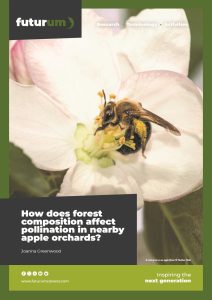
How does forest composition affect pollination in nearby apple orchards?
[[{“value”:”
How does forest composition affect pollination in nearby apple orchards?
Many apple orchards in the northeastern US rely on wild bees for pollination. Orchards that are surrounded by a larger amount of forest tend to be visited by a more abundant and diverse community of pollinators. But does the type of forest surrounding an orchard matter as well? At Rutgers University, Joanna Greenwood is studying this question to learn more about the relationship between pollinators, orchards and their surrounding forests.
Talk like an ecologist
Coniferous forest – forest dominated by cone-bearing, evergreen trees such as pine, spruce and fir
Deciduous forest – forest dominated by broad-leaved trees such as oak, beech and maple that shed their leaves annually
Insect collection vacuum – a device used to suck up insects for further observation
Yield – the amount of a crop that is produced in an orchard or other crop field
Picture yourself sat in the dappled shade of an orchard. A gentle breeze wafts the sweet scent of apple blossom through the air and gently rustles the leaves above you. All around, bees buzz from tree to tree, filling the warm afternoon with a soft, soothing hum. Believe it or not, this idyllic scene is the site of Joanna Greenwood’s field research.
Joanna, a PhD student at Rutgers University, is studying the relationship between forests, pollinators and apple orchards in the northeastern US. “Work by other researchers has shown that apple orchards that are closer to forest or surrounded by a larger amount of forest are visited by a more abundant and diverse community of pollinators,” she says. “Apple flowers can’t produce fruit unless they are visited by pollinators, which transfer pollen between flowers, so the higher abundance and diversity of pollinators near orchards results in more apples.”
But apple growers don’t only care about how many apples they produce; they also care about the quality of those apples – for example, how big and round they are. “Apples with more seeds tend to be larger and rounder, and each seed requires a grain of pollen to fertilise it,” says Joanna. “That means that more pollinators depositing more pollen can improve the quality of the fruit.”
Busy bees
Many kinds of insects visit apple flowers in the northeastern US, but bees are the most important apple pollinators because they deposit the most pollen on flowers. “Many apple growers rent managed honey bees to help with pollination,” says Joanna. “However, honey bees are expensive, and some wild bees, such as mining bees, are more effective at pollinating apple flowers.” If their orchards are surrounded by good habitat for wild bees, some apple growers decide not to rent honeybees and rely entirely on wild bees instead. For these growers, understanding the relationship between their orchards, the surrounding habitat and their wild pollinators is crucial.
A bee’s favourite forest
While several studies have found that the amount of forest surrounding an orchard impacts the number of pollinators it receives, Joanna wanted to find out whether the type of forest also has an impact. “The northeastern US has both coniferous and deciduous forests,” she says. “We know that bees prefer deciduous forests because they have more flowers, which bees need for food.” So, Joanna suspected that high surrounding forest cover wouldn’t benefit apple pollination if it wasn’t the type of forest that bees prefer.
“I designed a study to answer two questions,” says Joanna. “Firstly, do apple orchards surrounded by different types of forest (deciduous vs. coniferous) differ in the abundance and diversity of wild bees visiting apple flowers? And secondly, if that is the case, does this translate to differences in apple yield and quality?” To answer these questions, Joanna found six orchards surrounded by coniferous forest and six orchards surrounded by deciduous forest and collected data on the pollinators and apple yield at those orchards.
The big bee count
“To understand how many pollinator visits apple flowers were receiving at each orchard, we conducted visual visitation observations,” says Joanna. “This involved counting how many and what kind of insects visited a clump of flowers for a set period of time, then calculating how many visits each flower received per minute, on average.” However, it is difficult to identify most species of bee without looking at them under a microscope, so Joanna and her field technician, Kirah, also caught samples with an insect collection vacuum and took them back to the lab to determine which species were present in the orchards.
Reference
https://doi.org/10.33424/FUTURUM725
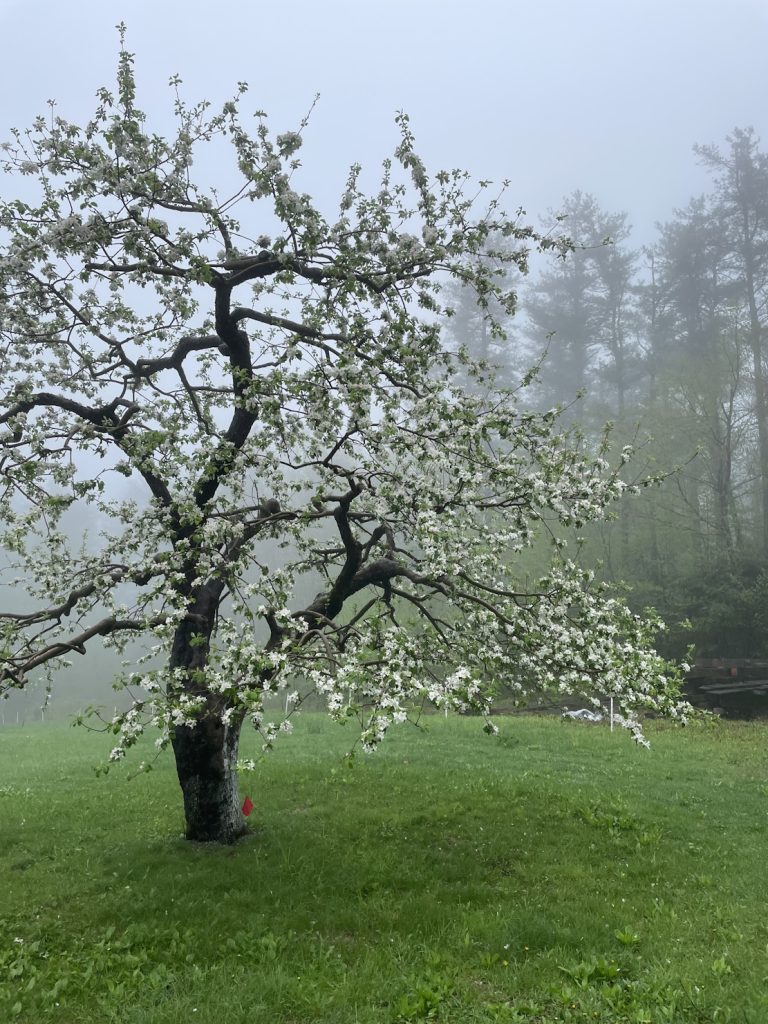
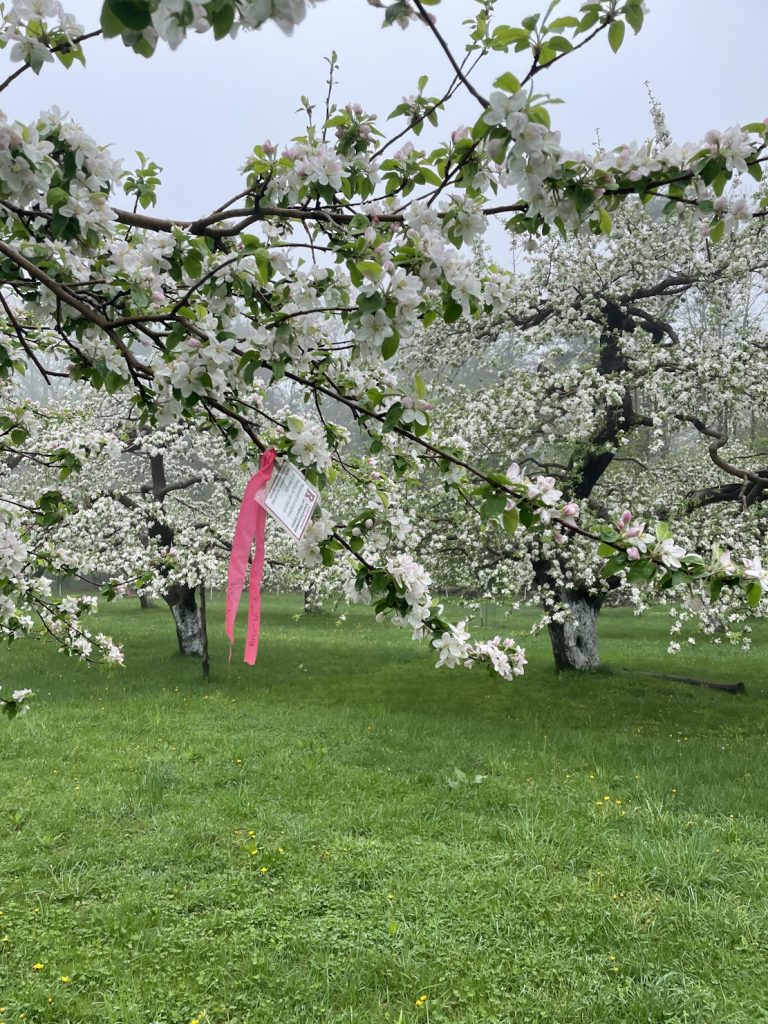
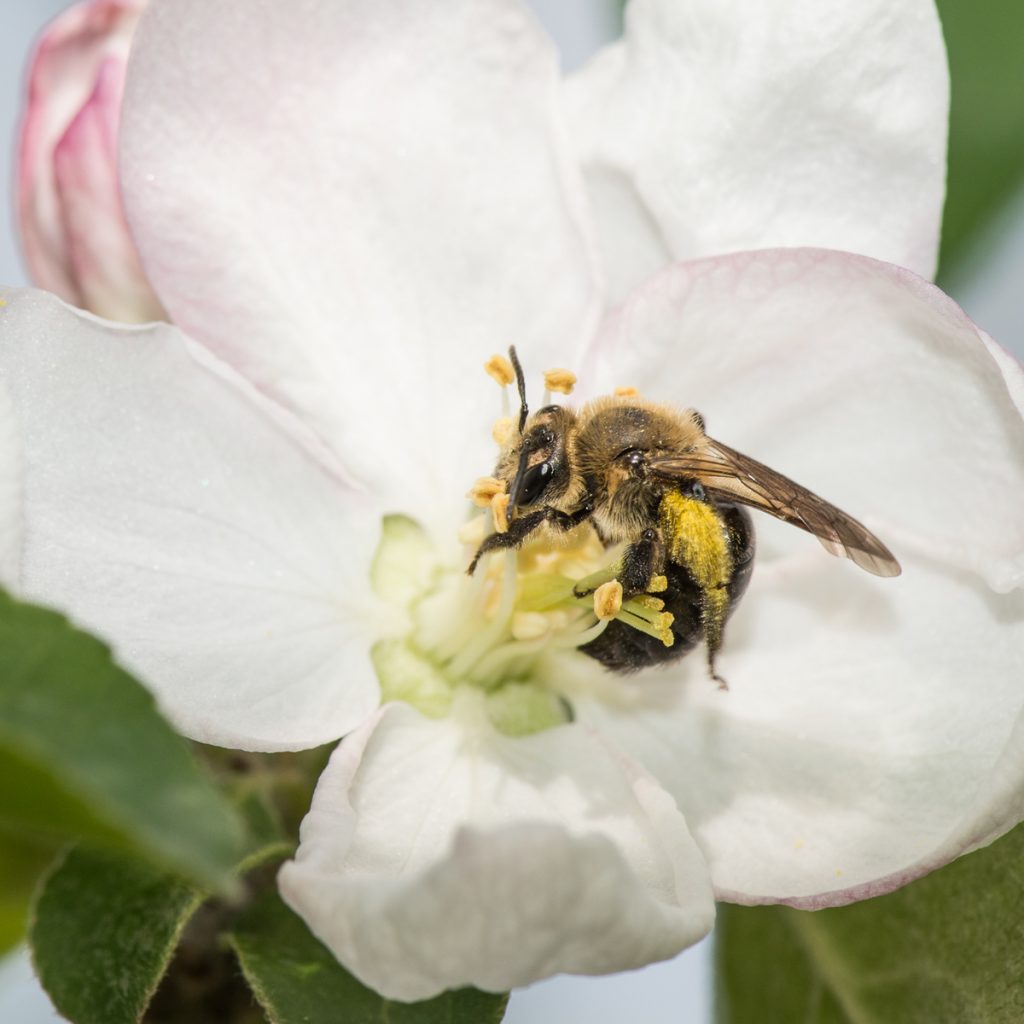

“We also determined the percentage of flowers that turn into fruits by marking branches on apple trees, counting the flowers and returning later to count the fruits,” says Joanna. “When the apples were ripe, we collected them and recorded their mass, whether they were approximately symmetrical, and how many seeds they had.” Counting the number of fruit allowed Joanna to figure out how many of the flowers were pollinated, and the number of seeds in each apple told her how well each flower was pollinated.
The results are in…
“Contrary to our expectations, we did not find a large difference in the diversity or visitation rate of wild bees in orchards surrounded by coniferous and deciduous forests,” says Joanna. However, she did find that orchards with higher wild bee diversity and visitation rates had apples with more seeds. “These apples were larger and more symmetrical, making them more valuable,” Joanna continues. “So, our results confirm that higher abundance and diversity of wild bees contributes to the production of higher-quality apples.”
Joanna is unsure why she didn’t find the results that she expected, so she will be doing more data analysis to dig a little deeper. “If we could repeat the study with more orchards, we may be able to better understand these relationships,” she says. “It is also likely that other variables – such as the amount of pesticide used in the orchards – affected our results.”
For the love of bees
“As crop pollinators, bees are critical for human wellbeing – but I find them fascinating in and of themselves; there are over 20,000 species of bees worldwide, and each one is unique and beautiful,” says Joanna. “My favourite part of my job is spending time outdoors collecting data, but I also love talking to people about my research and about bees in general.” Despite not finding the results that she expected, Joanna is excited to continue her investigation of the relationship between bees and orchards. When she’s in an orchard surrounded by sweet apples and buzzing insects, there’s really no place she’d rather bee.
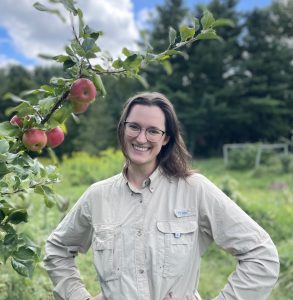 Joanna Greenwood
PhD Student, Winfree Lab, Rutgers University, USA
Fields of research: Ecology
Research project: Studying the effects of forest composition on pollinators and yield in adjacent apple orchards and linking forest management and crop production
Funder: United States Department of Agriculture (USDA), National Institute of Food and Agriculture, award number 2024-67011-42897
Do you have a question for Joanna?
Write it in the comments box below and she will get back to you. (Remember, researchers are very busy people, so you may have to wait a few days.)

Learn about how bees support agriculture:
futurumcareers.com/bringing-beekeeping-and-berry-farming-to-alberta
The post How does forest composition affect pollination in nearby apple orchards? appeared first on Futurum.
“}]]