
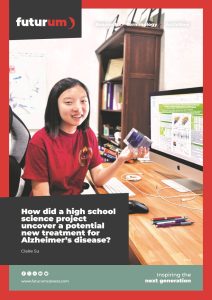
How did a high school science project uncover a potential new treatment for Alzheimer’s disease?
[[{“value”:”
How did a high school science project uncover a potential new treatment for Alzheimer’s disease?
It was an 8th Grade biology lesson that inspired Claire Su, a high school student at BASIS Ahwatukee in the US, to conduct her own scientific research project. After learning about the gene that causes people to perceive the taste of brussels sprouts differently, she decided to investigate the links between this gene and Alzheimer’s disease. Mentored by scientists at Arizona State University, Claire not only discovered that supertasters have a lower risk of Alzheimer’s, but she also found that a drug currently used to treat diabetes could be repurposed to prevent cognitive decline.
Talk like a computational neuroscientist
Allele – a variation in a gene
Alternative allele – an allele that is different to the reference allele in the human reference genome
Alzheimer’s disease – a progressive brain disorder that causes cognitive decline
Cognitive decline – the loss of cognitive abilities such as thinking and memory
Genotype – the alleles that a person has for a particular gene (e.g., the taster genotype defines which TAS2R38 alleles a person has, categorising them as a supertaster, nontaster or heterozygote)
Heterozygote – a person whose TAS2R38 gene contains both the reference allele and the alternative allele
MGAM – the gene that produces an enzyme to digest starch
TAS2R38 – the gene that influences a person’s ability to taste certain bitter compounds, such as those found in brussels sprouts
Do you like brussels sprouts? These vegetables famously divide opinion over whether they are delicious or disgusting. If you can’t stand brussels sprouts, you aren’t being a fussy eater – you probably have a genetic disposition to find the taste unpleasant.
“The TAS2R38 gene is a taste receptor that affects people’s sensitivity to bitter compounds, such as those in brussels sprouts,” says Claire Su, a high school student at BASIS Ahwatukee in the US. “If someone has the supertaster variant of the gene, they can perceive bitter taste compounds and so may have an aversion to foods containing these.” People with the nontaster variant are unable to taste the bitter compounds in brussels sprouts, and heterozygotes’ taste perceptions lie between supertasters and nontasters.
What inspired Claire to research taste genes?
Claire first learnt about supertaster genes in her 8th Grade biology class. “I was curious whether perceptions of taste might connect with memory, since I had heard that taste and smell are often connected with cognitive abilities,” she says. “I wanted to study if there was a connection between TAS2R38 and Alzheimer’s disease.” And so, in 9th Grade, Claire joined a science fair club where she was mentored by scientists from Arizona State University who supported her as she conducted her own scientific research project.
How did Claire investigate links between taste genes and Alzheimer’s?
Claire analysed data from over 2,000 people who had taken part in the Alzheimer’s Disease Neuroimaging Initiative (ADNI). First, she examined their genetic data to determine their taster genotype (whether they were a supertaster, nontaster or heterozygote) by examining the alleles in three locations on the TAS2R38 gene. Supertasters have two copies of the alternative allele in the first and third location, while nontasters have two copies of the alternative allele in the second location, and heterozygotes have one alternative allele and one reference allele.
Claire then compared these people’s taster genotypes with their Alzheimer’s biomarkers. This included numerical scale ratings, such as their Clinical Dementia Rating, as well as imaging data collected from brain scans, such as the presence of amyloid and tau proteins that build up in the brain during cognitive decline.
“I found that alternative first and second TAS2R38 alleles are positively correlated with biomarkers for cognitive decline, while an alternative third allele is negatively correlated with cognitive decline,” Claire says. “As supertasters have alternative first and third alleles, the positive and negative effects counteract each other, resulting in a slower rate of cognitive decline compared to nontasters, who only have alternative second alleles. Thus, my results showed that TAS2R38 supertasters displayed a lower risk of Alzheimer’s.”
Reference
https://doi.org/10.33424/FUTURUM719

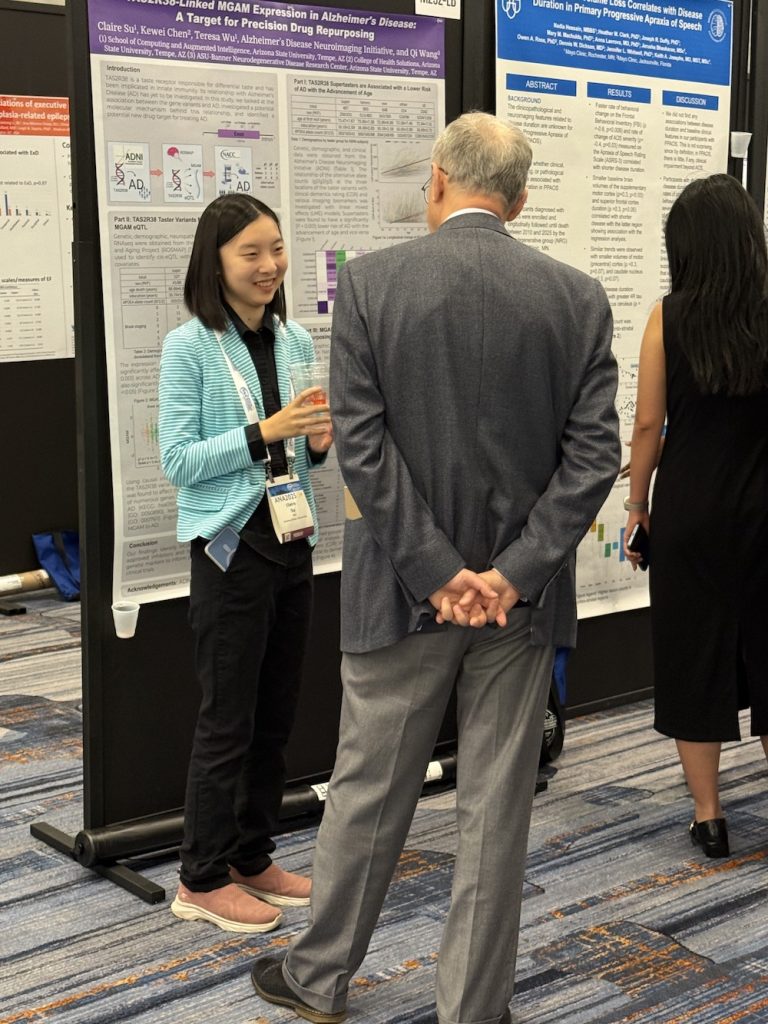
Next, Claire analysed genotype data from over 900 people who had taken part in the Religious Orders Study and Memory and Aging Project (ROSMAP). “I connected genotype data to the expression of nearby genes in the genome to find a potential molecular mechanism behind the association,” she explains. She discovered that the TAS2R38 gene variants themselves do not directly impact the risk of Alzheimer’s. Instead, Claire found that they act as expression quantitative trait loci, meaning they mediate the expression of nearby genes, and she identified the MGAM gene (which produces an enzyme to digest starch) as being affected. “I found that the supertaster variants are associated with a lower expression of MGAM in the Alzheimer’s-affected brain regions, and vice versa,” she says, indicating that a higher expression of MGAM is linked to cognitive decline.
Finally, Claire analysed data from the National Alzheimer’s Coordinating Center (NACC) to investigate whether MGAM-inhibiting drugs could reduce the risk of Alzheimer’s. “MGAM is a target for diabetes treatment and drugs inhibiting its expression have already been developed, which allowed me to investigate how the drug could affect the susceptibility to Alzheimer’s,” she explains. Claire found that people taking MGAM-inhibiting drugs do indeed have slower rates of cognitive decline, suggesting that these diabetes drugs could be repurposed for treating Alzheimer’s. Claire’s mentors are now exploring her findings further through animal model testing, with the aim of evaluating their potential for translation into clinical practice.
What next for Claire?
Since completing her science fair project, Claire has written up her findings and, with the support of her mentors, published them in an academic journal so that scientists and doctors around the world can learn from her work. But this wasn’t always an easy journey. “The research experience was hard at first because I knew very little about coding and data analysis when I began, but I have now become fluent in these skills,” Claire says. “There were always setbacks, such as when results weren’t statistically significant or when my code disappeared and I had to redo whole portions of the project.” However, the joys have greatly outweighed the challenges. “The moments when I got significant results really excited me!” says Claire. “During the gene expression analysis, it was fascinating to learn about lots of genes that I’d never heard of before.”
Now in 12th Grade, Claire is looking forward to going to college to study cognitive science. “I’m drawn to understanding human thought and how people see the world differently,” she says. “I want to continue doing research as I’m constantly reminded about what a big and unexplored world the human body really is and how research can help improve diagnosis and treatment of diseases.”
Claire’s story highlights how curiosity born from a science lesson can lead to remarkable new scientific discoveries, as what began as a high school science project has resulted in a potential new treatment for a devastating disease.
 Claire Su
BASIS Ahwatukee, Phoenix, Arizona, USA
Field of research: Computational neuroscience
Research project: Investigating the links between the TAS2R38 taste gene and Alzheimer’s disease
Research paper: TAS2R38 taster variants-linked MGAM expression in Alzheimer’s disease: a novel target for precision drug repurposing. Su et al. (2026) doi: 10.3389/fnagi.2026.1768436
Do you have a question for Claire?
Write it in the comments box below and she will get back to you. (Remember, researchers are very busy people, so you may have to wait a few days.)

Learn how neuroscientists are investigating the link between the gut microbiome and Alzheimer’s disease:
futurumcareers.com/exploring-the-link-between-the-gut-microbiome-and-alzheimers-disease
The post How did a high school science project uncover a potential new treatment for Alzheimer’s disease? appeared first on Futurum.
“}]]