
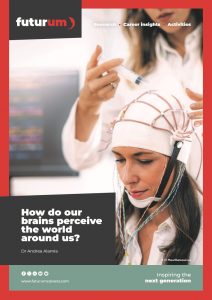
How do our brains perceive the world around us?
[[{“value”:”
How do our brains perceive the world around us?
For a long time, neuroscientists thought of the brain as a passive receiver of sensory information, waiting patiently to receive input from our eyes, ears and other sensory organs. However, predictive coding theory flips this idea on its head and proposes that our brains actively make predictions about the world around us, only using sensory information to correct their mistakes. Dr Andrea Alamia at the Centre national de la recherche scientifique in France is investigating this theory and exploring its impacts on other areas of science.
Talk like a computational neuroscientist
Alpha-band oscillations – rhythmic electrical pulses in the brain that help regulate the processing of sensory information
Autism – a neurodevelopmental difference that affects how a person perceives the world
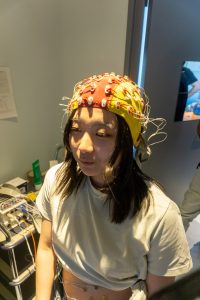
Electroencephalogram (EEG) – a non-invasive test that records brain activity through small metal discs attached to the scalp
Predictive coding – a theory proposing that the brain constantly generates predictions about the world, rather than passively waiting for sensory input
Schizophrenia – a severe mental illness that causes a person to feel disconnected from reality, sometimes resulting in hallucinations or delusions
Travelling waves – repeated patterns of neural activity that spread across the brain
Picture the scene: the lunch bell rings after a long morning of complicated algebra and dense poetry. After racing to the canteen, you rip your cheese sandwich out of its wrapper, chomp down and begin to chew… Eugh! You spit the sandwich out in disgust and stare at it in bemusement, slowly realising that you accidentally packed your brother’s egg mayonnaise sandwich in your lunchbox this morning. While your friends may laugh at your misfortune, this unexpected situation can actually reveal a lot about how our brains work.
Predictive coding
“According to predictive coding theory, our brains are constantly generating predictions about incoming sensory information based on previous experiences and comparing these predictions with the actual sensory information we receive,” explains Dr Andrea Alamia from the Centre national de la recherche scientifique. If the incoming sensory input matches the prediction, our brain suppresses it to save energy. However, if there is a prediction error (such as tasting egg when you expected cheese), your brain takes notice and searches for new information to update its prediction.
“In this framework, our perception emerges from an interaction between ‘top-down’ predictions and ‘bottom-up’ sensory signals,” says Andrea. This differs from traditional theories which emphasised the flow of incoming sensory information up to higher areas of the brain. “In contrast, predictive coding proposes a continuous two-way exchange between higher and lower levels of the brain,” continues Andrea. “Rather than passively registering sensory input, predictive coding suggests that the brain actively suppresses or flags the sensory information we receive.”
Alpha-band oscillations
So, how does your brain control which sensory inputs you pay attention to and which you ignore? Well, the answer lies in alpha-band oscillations – rhythmic patterns of electrical brain activity that cycle at a frequency of 8 to 12 times a second. These ‘alpha rhythms’ spike when you close your eyes and relax, so for many years, scientists thought they were just the background hum of a brain that didn’t have much to do.
However, many scientists now think that alpha rhythms have a much more active role as the brain’s noise-cancelling filter that supresses unnecessary information. For example, as you’re reading this article, your brain boosts alpha rhythms in regions that are receiving distracting sensory input, such as the auditory cortex. At the same time, it reduces alpha rhythms in your visual cortex, allowing you to focus entirely on the words you are reading.
“This is a fairly simple explanation and we are still trying to figure out the nuances, but it seems that alpha rhythms help to regulate when and where populations of neurons become excitable, making them more likely to receive and process information,” explains Andrea. “Scientists in our field are still actively debating this topic and some experiments suggest that the relationship between alpha oscillations and perception is not always straightforward. This is science in action!”
Travelling waves
Sometimes, alpha-band oscillations sweep through the brain like waves moving through water. Andrea discovered that these alpha travelling waves could be the mechanism that underlies predictive coding. “We showed that alpha travelling waves moving forwards or backwards through the brain emerge under different conditions,” he says. “These movements are consistent with the predictive coding model that describes how predictions and prediction errors would flow through the brain.”
For example, forward-travelling alpha waves move from the back of the brain, where sensory information is received, to the frontal lobe, where decision-making takes place. These forward waves represent bottom-up sensory processing and emerge when you are actively paying attention to sensory inputs. In contrast, backward-travelling alpha waves move from the frontal cortex to the sensory regions at the back of the brain. These waves represent the top-down predictions that your brain is making and filter out the unnecessary sensory information you are receiving.
“Our work provided a bridge between a prominent theoretical framework and observable brain dynamics,” says Andrea. “Through a computational simulation, we generated predictions about how travelling waves should change in different perceptual states, based on the theory of predictive coding.” Andrea and his team validated these predictions in experiments, measuring participants’ brain activity using an electroencephalogram (EEG), to provide concrete evidence that supports predictive coding theory.
Predictive coding in action
Since providing this evidence, Andrea has been exploring how predictive coding theory could be applied to other areas of science. For example, he is investigating whether it can be used to explain conditions such as schizophrenia and autism. “These conditions may involve atypical weighting of top-down predictions or bottom-up sensory inputs,” explains Andrea.
By comparing EEG data from schizophrenia patients to healthy control participants, Andrea found that those with schizophrenia displayed stronger backward-travelling alpha waves. This indicates that their brains give more weight to internal predictions and heavily suppress sensory inputs, potentially leading to hallucinations and delusions that do not align with reality. On the other hand, Andrea conducted a similar study with autistic participants and found that they displayed stronger forward-travelling waves, indicating that their brains are less likely to suppress sensory information. This could explain why some people with autism experience sensory overload and extreme attention to detail.
Reference
https://doi.org/10.33424/FUTURUM717
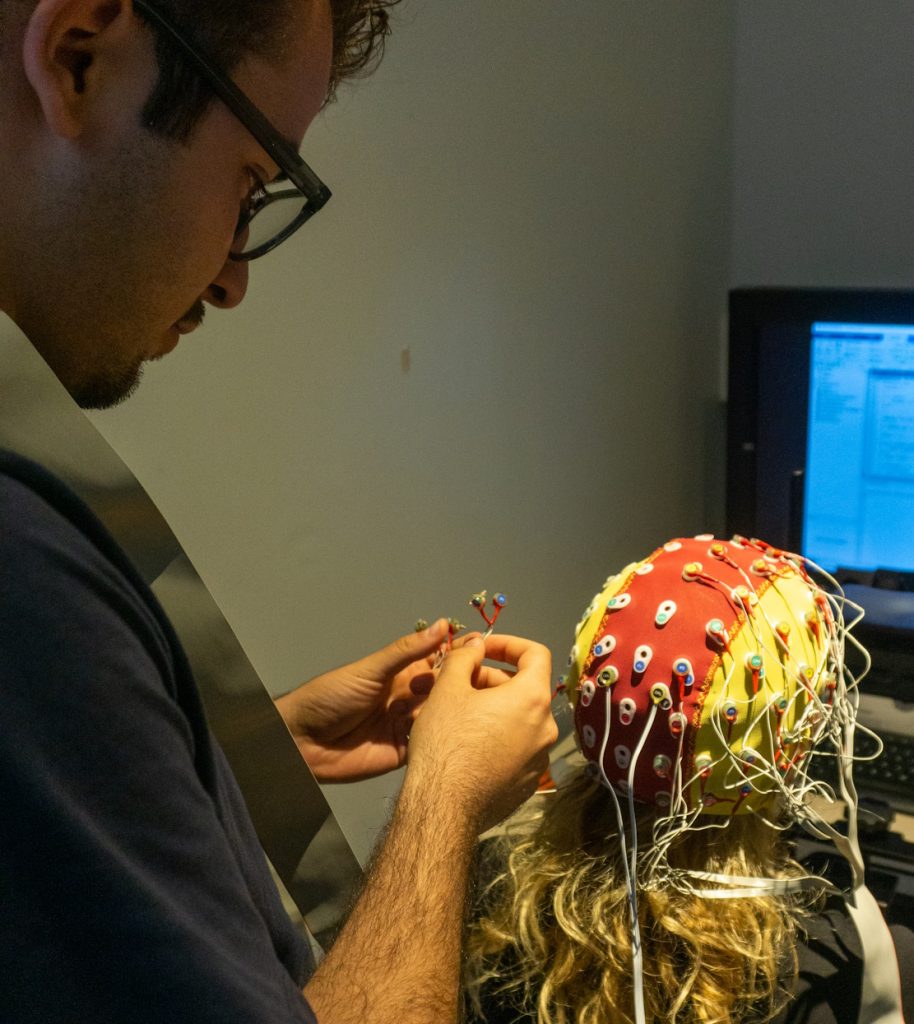
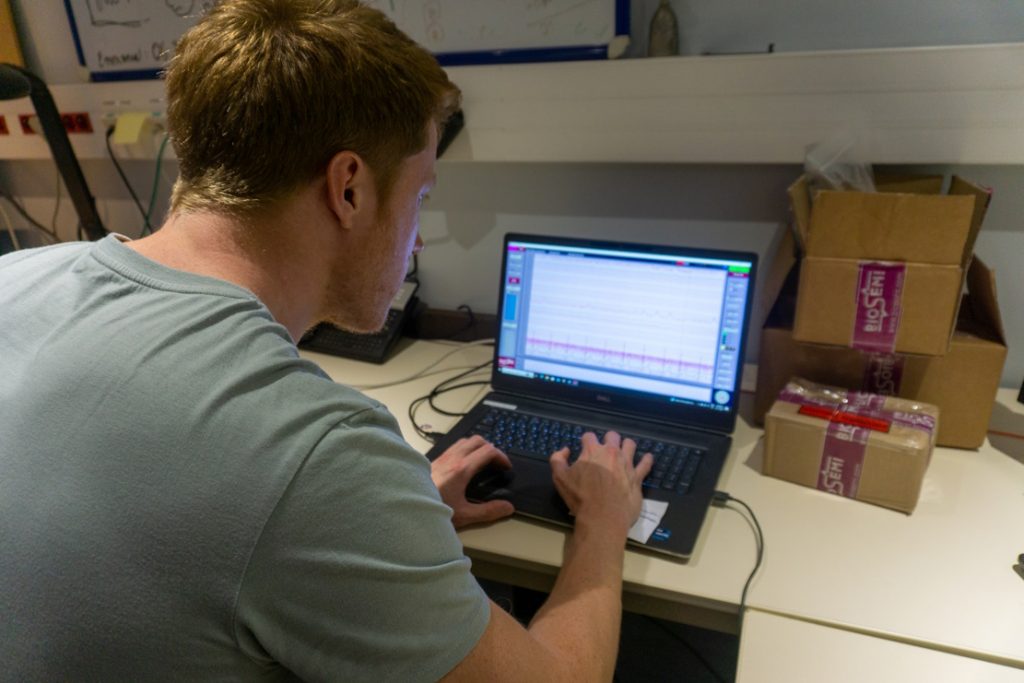
Quentin Guardia, another Master’s intern, keeping a close eye on the EEG signals to make sure every recording is high quality.

Predictive coding principles can also be applied to computer vision, a type of artificial intelligence that can interpret and understand images and videos. “This theory offers a framework in which perception is guided by prior expectations as well as incoming sensory data,” Andrea explains. “This approach makes image recognition more robust when an image is blurry or incomplete, allowing computer vision systems to be more accurate and resilient.”
Under controlled, regulated conditions, Andrea is also studying how psychedelic drugs disrupt the balance between prediction and sensory input. “Studying these effects provides a unique opportunity to investigate the neural mechanisms underlying perception, cognition and consciousness,” he says. “Ultimately, the goal is to develop a more unified understanding of how brains generate perception and experience.”
 Dr Andrea Alamia
Researcher, The Brain and Cognition Research Centre (CerCo), Centre national de la recherche scientifique (CNRS), France
Field of research: Computational neuroscience
Research project: Investigating how alpha travelling waves in our brains affect our perception
Funder: European Research Council (ERC; Grant agreement No. 101075930)
Website: artipago.github.io
About computational neuroscience
“Computational neuroscience aims to answer some of the biggest questions about how the brain generates perception, thought and consciousness,” explains Andrea. “However, one of the biggest challenges in the field is that the brain is an incredibly complex system, and no single discipline provides all the tools needed to understand it.” Luckily, the field is one of the most interdisciplinary areas of science, so researchers often work together to combine knowledge from neuroscience, mathematics, programming, statistics and psychology.
Technological advances, such as artificial intelligence and brain imaging, are creating unprecedented opportunities to understand how the brain operates. “The next generation of researchers will have access to richer datasets and more powerful computational tools than ever before,” continues Andrea. “This opens exciting possibilities for understanding brain disorders, improving AI systems and uncovering the fundamental principles of intelligence and cognition.”
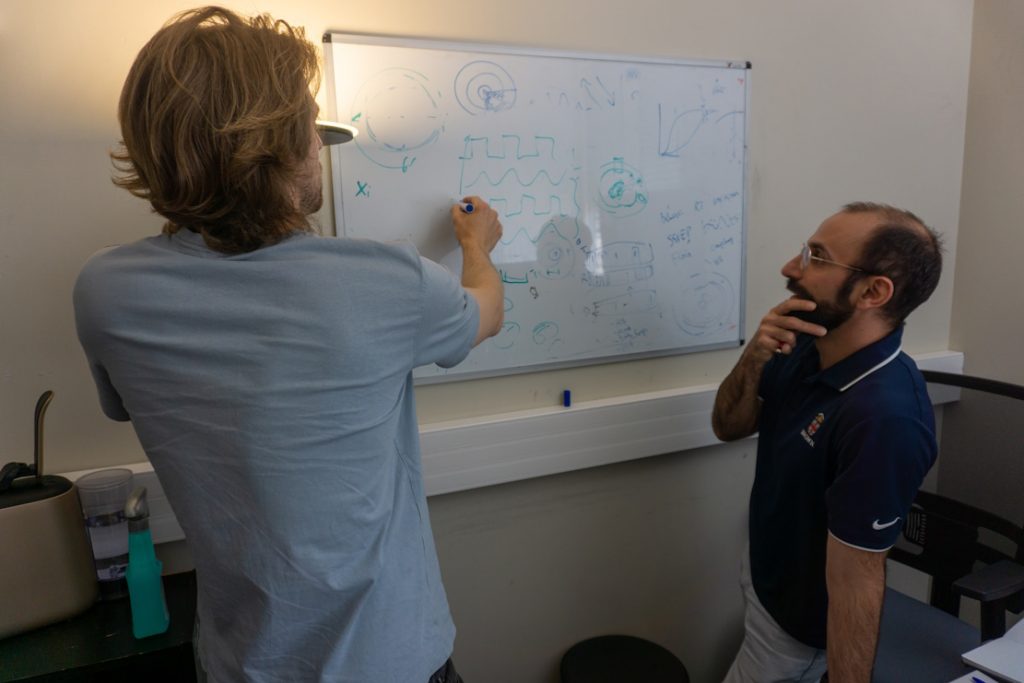
A typical day in the life of a computational neuroscientist involves a mixture of data analysis, programming, reading scientific papers and thinking about how to develop computational models or new approaches. “I spend quite a bit of time analysing brain recordings to test our hypotheses and evaluate the results of our experiments,” says Andrea. “I also spend time writing code, running simulations and meeting with collaborators, which is especially important on interdisciplinary projects.” Andrea also mentors students and discusses projects with postdocs. “These interactions generate new ideas and help us assess the progress of different projects,” he continues. “Interestingly, no two days are the same, which is one of the field’s appealing aspects!”
Students can best prepare for a career in computational neuroscience by developing strong quantitative and analytical skills – particularly in mathematics and coding – and by having a keen curiosity about biological and psychological questions. “Critical thinking, scientific communication skills and the ability to work across disciplinary boundaries are equally important,” says Andrea.
Pathway from school to computational neuroscience
At school, Andrea suggests studying mathematics, physics and computer science whenever possible. “At university, degrees in neuroscience, psychology, computer science, mathematics, physics, engineering or related disciplines can all provide strong foundations,” he says.
Learn programming languages such as Python and gain experience with statistics and data analysis. “These are particularly valuable and could make life easier at later stages, such as during a PhD,” says Andrea. “In my opinion, although large language models (like ChatGPT) are changing our approach to coding, learning to code is still one of the most valuable investments a student can make as it will help them think in a logical and structured manner.”
Students can also benefit from summer research projects, internships and coding workshops.
Explore careers in computational neuroscience
“Career opportunities include academic research, healthcare technology, artificial intelligence companies, neurotechnology, pharmaceuticals and data science,” says Andrea. “The interdisciplinary nature of the field means that graduates often have a wide range of career options.”
Online courses, conference talks and educational resources provide excellent starting points to explore different fields. For example, the British Neuroscience Association has a suite of educational resources for students of all ages.
The Société des Neurosciences in France has a programme that aims to guide young neuroscientists in their careers.
Meet Andrea
As a teenager, I was passionate about science fiction (especially Isaac Asimov’s books) as well as dinosaurs and sports. I also practiced judo and breakdancing for many years! While I can’t say these interests directly determined my career path, they certainly helped shape my curiosity and my attitude about the world. Sports, in particular, taught me perseverance, discipline and the importance of enjoying what you do.
Reading Asimov’s books sparked a fascination with artificial intelligence and, more broadly, with understanding the human mind. That led me to become interested in psychology, cognition and neuroscience, even before I fully understood what those fields involved. Today, that curiosity and passion for understanding how the mind works remains my strongest motivation and continues to drive my research.
What I love most about being a researcher is the freedom it offers to investigate what really interests and impassions me. I have the opportunity to learn something new every day, and I enjoy the intellectual challenge of solving problems and understanding how things work. The combination of discovery, creativity and continuous learning makes the job incredibly rewarding.
It is important to maintain a sense of enjoyment and curiosity throughout your career. I was fortunate to have opportunities to move between countries for my PhD, postdoctoral training and eventually my permanent position. These experiences allowed me to explore new environments, meet inspiring people, exchange ideas and learn from different perspectives. I believe that being humble, open-minded and passionate are the key ingredients for success. Most other skills can be learned along the way.
Sport is still a big part of my life. Recently, I’ve been practising capoeira, a Brazilian martial art, and going to the gym with a friend. I also enjoy playing chess online, although it can become a little competitive at times! Outside of that, I love going to the cinema with my girlfriend or spending time with friends, enjoying an apéro (evening drink) along the Garonne River in Toulouse.
Andrea’s top tips
1. Don’t focus solely on the most prestigious universities or institutions. Instead, look for supervisors and mentors who will genuinely support your growth, value your work and
encourage your passion.
2. Maintain a healthy work-life balance and keep your enthusiasm and curiosity alive throughout your journey.
Do you have a question for Andrea?
Write it in the comments box below and he will get back to you. (Remember, researchers are very busy people, so you may have to wait a few days.)

Learn about how we learn about how our brains perceive and extract information from faces:
futurumcareers.com/how-do-our-brains-extract-information-from-faces
The post How do our brains perceive the world around us? appeared first on Futurum.
“}]]