
What can pottery from the past teach us about containment today?
[[{“value”:”
What can pottery from the past teach us about containment today?
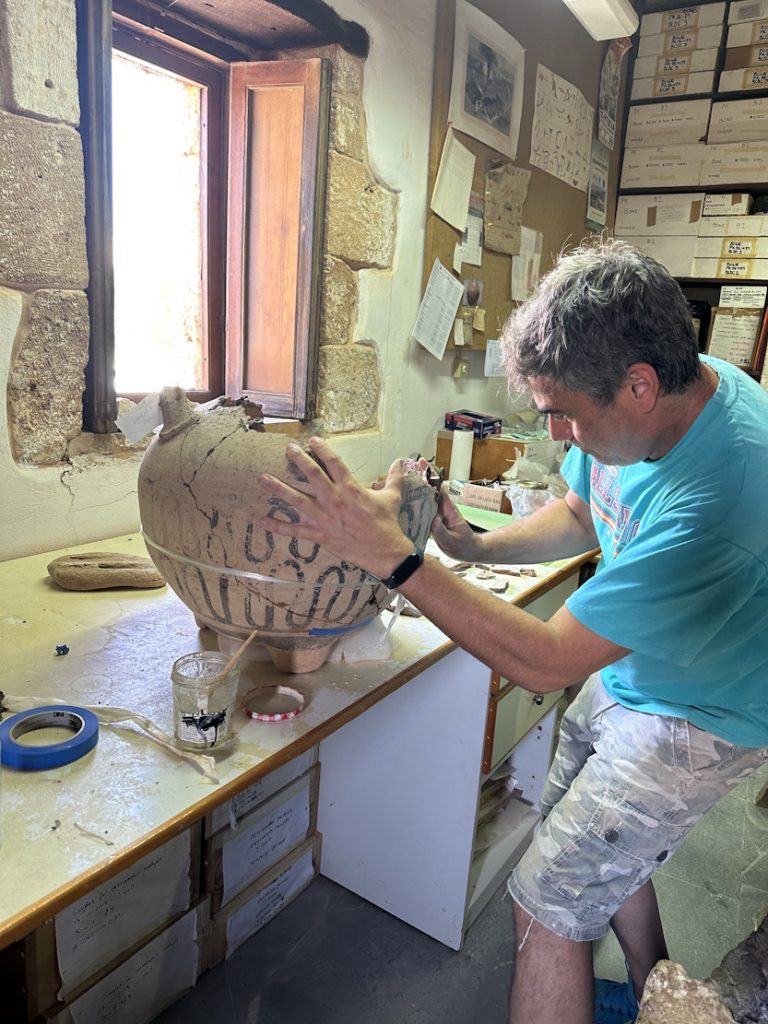
In a storeroom on the coast of the Greek island of Crete, a team of archaeologists is attempting an almost-4000-year-old 3D jigsaw puzzle. Led by Professor Carl Knappett from the University of Toronto in Canada, these archaeologists are piecing together pottery fragments they have excavated from the Minoan site of Palaikastro. By restoring these ancient pots and vases, the team is shedding light on Bronze Age society and asking questions about what ‘containment’ means today.
Talk like an archaeologist
Artefact — physical objects (material culture) excavated by archaeologists
Bronze Age — the archaeological period characterised by the widespread use of bronze which, in Europe, occurred from 3200 BCE to 800 BCE
Containment — the act of confining something within boundaries
Egalitarian — the principle that everyone is equal and deserves the same rights and opportunities
Excavation — the process of uncovering buried artefacts and structures
Material culture — any physical objects or spaces (e.g., pottery, tools, artwork, buildings) that contribute to the culture of a place
Minoan — a Bronze Age civilisation that existed on the island of Crete from 3000 BCE to 1100 BCE
Sherd — a fragment of pottery
“Think of all the things that surround you – your phone, street signs, desks in your classroom,” says Professor Carl Knappett. “This is ‘material culture’. You may not pay these items much attention because they are so much a part of your daily life, but they can be very informative once you start noticing.”
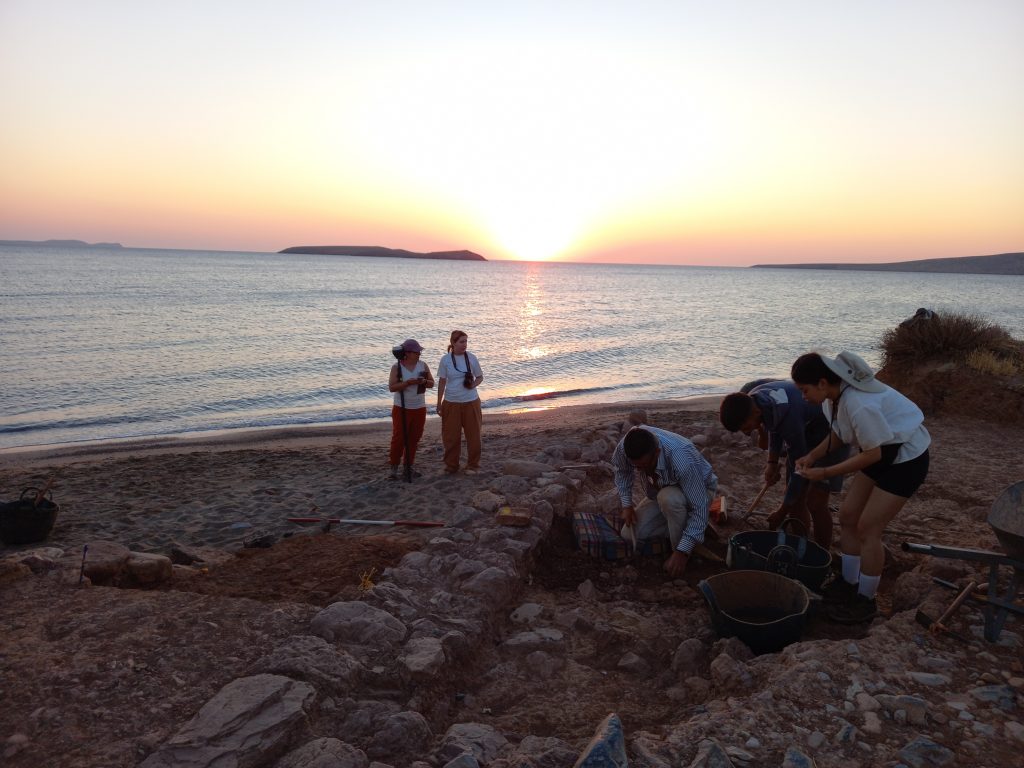
As an archaeologist from the University of Toronto, uncovering and analysing material culture is exactly what Carl spends every summer doing at Palaikastro, an archaeological site on the Greek island of Crete. In 1700 BCE, during the boom of Minoan civilisation in the Bronze Age, Palaikastro was a bustling harbour town where the inhabitants relied on the sea for food and trade. They made textile dyes out of shells, grew cereals, vines and olive trees, and kept sheep and goats. “The people were skilled in a range of crafts,” says Carl. “They made bronze tools and weapons, stone vases, and pottery.”
Excavating Palaikastro
The history of excavating Palaikastro goes back many years, as archaeologists first started working on the site in 1902. Carl has been leading projects there for the last twenty-five years. When most people think of archaeology, they imagine digging into the ground to excavate artefacts. However, modern archaeologists also use a range of specialist equipment and techniques.
“We use geophysical techniques like radar and magnetometry to ‘see’ remains below the surface, and we use drones to take high resolution survey photos from the air,” explains Carl. “We take soil samples so we can recover tiny plant remains to analyse human-plant interactions.” To document the buildings, the team 3D-scans the remains of architecture to make accurate reconstructions. “And a dive team has recently been surveying underwater, documenting submerged Bronze Age buildings as well as a Roman shipwreck.”
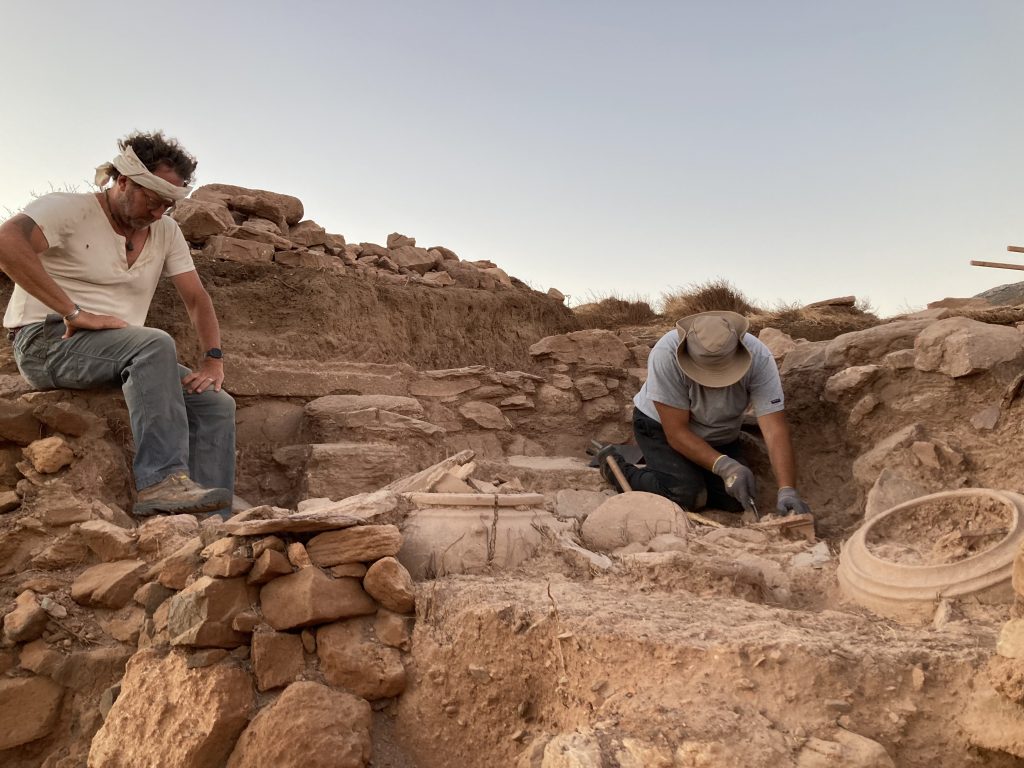
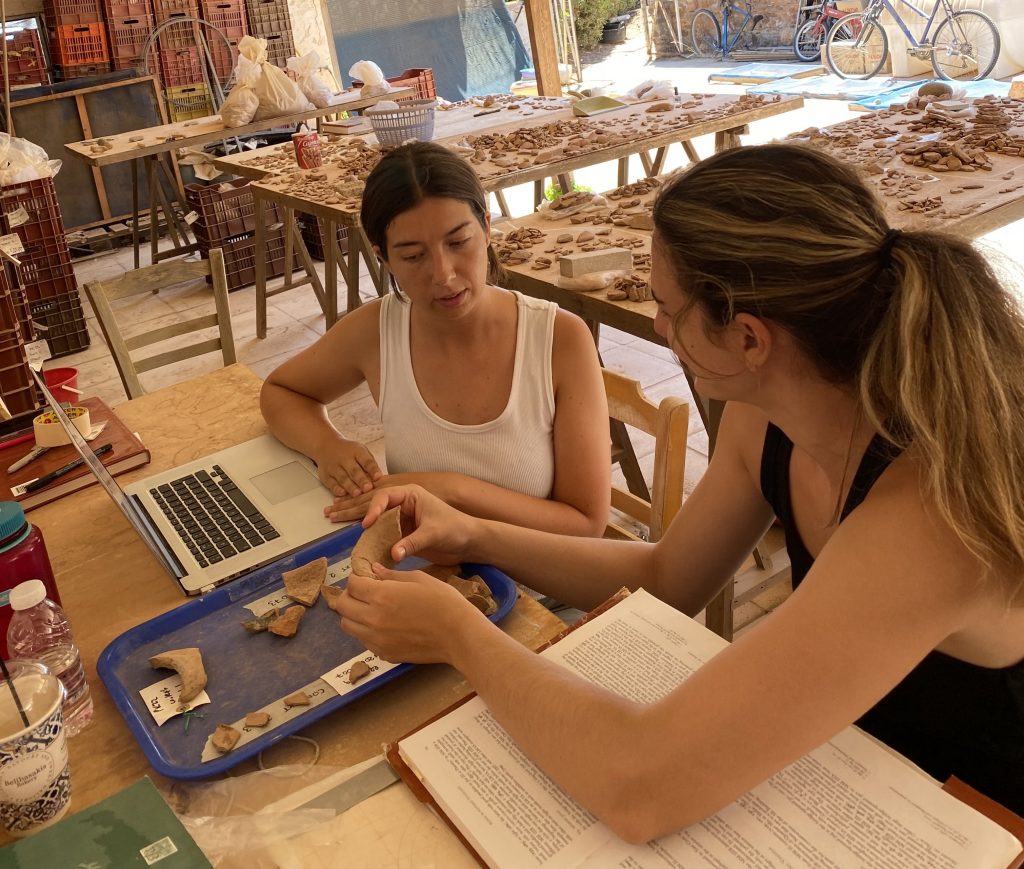
Carl’s team does still excavate by hand, which is how they find material culture. This mainly consists of millions of pottery fragments, known as sherds, that must be painstakingly reassembled. Over the years, archaeologists have almost fully reconstructed thousands of pottery vessels from sherds, which have given them considerable insight into how the inhabitants of Palaikastro lived. “In the Bronze Age, people used pottery for everything, from eating and drinking, to transporting olive oil and wine, to cooking and lighting their houses,” says Carl.
Finding patterns in the past
Once the team has uncovered and reassembled pottery sherds, the next step is to figure out what the items can teach us about the past. “To ascertain how people lived, we try to find patterns that can explain why certain vessels were found where they were,” explains Carl. “For example, are there lots of cups and jugs stored in a cupboard next to a hall, suggesting people gathered and celebrated there? Do we find many jars in certain rooms that indicate substantial storage, and could this imply that some families were wealthier than others?”
As well as questions about exactly how items were used, Carl also asks how the pottery was made. “Were there many craftspeople? Did they all use the same materials and techniques? Were they all equally skilled?”
What has Carl discovered?
One of the fascinating things Carl has noticed over the years is how none of the pottery vessels he has excavated at Palaikastro have been particularly different to the rest. “That may sound a bit negative, but it’s actually quite the opposite!” he enthuses. “This is interesting because what it means, in my opinion, is that everyone back then had access to the same resources. We don’t see fancy houses where some inhabitants had much nicer things than everyone else. In every house we find much the same set of pottery vessels.”
Another discovery along the same lines is that no palace has ever been found in Palaikastro, even though most other Minoan towns on Crete had one. “This makes me think that the inhabitants here found a way of living that was more egalitarian,” says Carl. “This is fascinating as it shows that, even on an island, people in different settlements didn’t all live in the same way.”
What else can Bronze Age pottery teach us?
Learning about the past can inspire interesting philosophical questions about how we live today. “The more I study ancient pottery, the more I feel it is essential to think not about the vessel standing in front of you, but about the ‘invisible’ elements for which it was ultimately designed. That is to say, the liquids it was to contain, or the heat it was supposed to withstand when on the hearth,” says Carl. “We easily forget that pretty much all these Minoan pots we study were used for containment of one form or another. Once we make containment our focus, we can make better sense of both use and design.”
Considering the external container and internal contents of objects and spaces is philosophically relevant today. “In the modern world, we are surrounded by and immersed in containment, but it is easy not to give containment a second thought,” says Carl. “Our houses and vehicles contain us, and we carry containers such as bags and coffee cups. Why do you put clothes in a wardrobe? Why is fruit that is contained in its own skin wrapped in plastic in the supermarket? With all these containers, is it any wonder that we need to ‘think outside the box’?!”
By studying the past and uncovering objects from thousands of years ago, archaeologists like Carl gather insights not only into how people used to live, but also into how we approach our own lives today.
Professor Carl Knappett
Department of Art History, University of Toronto, Canada
Field of research: Archaeology
Research project: Excavating and analysing pottery containers from the Minoan site of Palaikastro in Crete, Greece
Collaborators: Chrysa Sofianou (Lasithi Ephorate of Antiquities, Greece); Dr Theotokis Theodoulou (Ephorate of Underwater Antiquities, Greece); Dr Andrew Shapland (Ashmolean Museum, Oxford, UK)
Funders: Social Sciences and Humanities Research Council of Canada (SSHRC); US Institute for Aegean Prehistory; Hal Jackman Foundation; University of Toronto; British School at Athens
Website: amc.art.utoronto.ca
About archaeology
“Being an archaeologist gives you a unique perspective on the past,” says Dr Rachel Phillips, an archaeologist who works at Palaikastro. “Just one object can tell us so much about people in the past – what they ate and drank, or how they lived.”
Reference
https://doi.org/10.33424/FUTURUM674
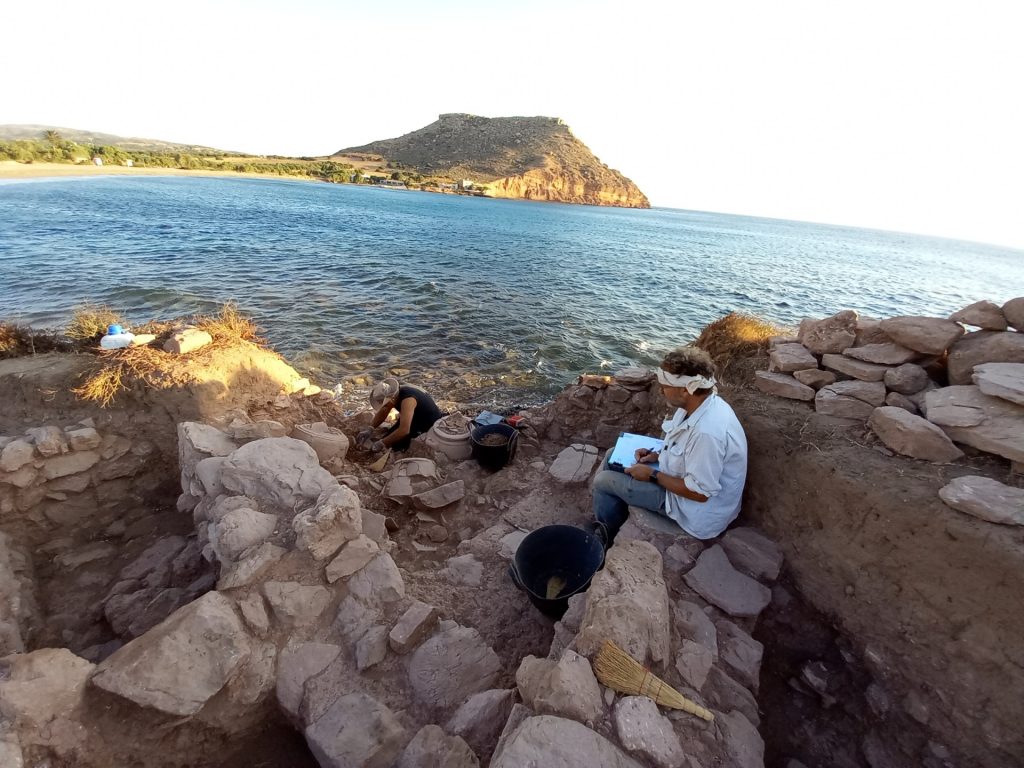
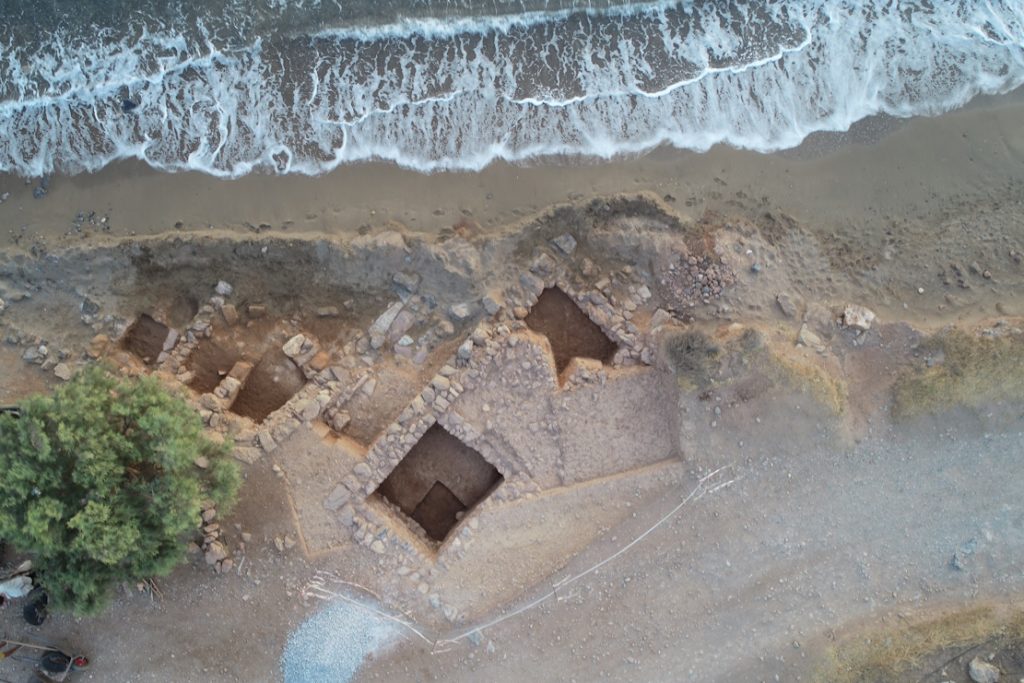
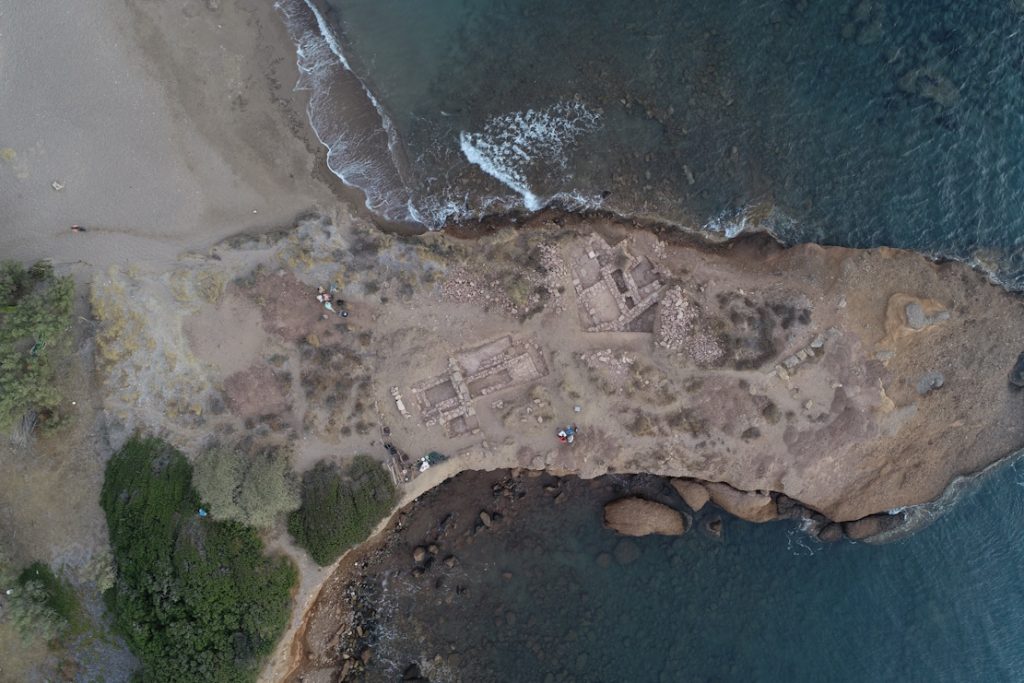
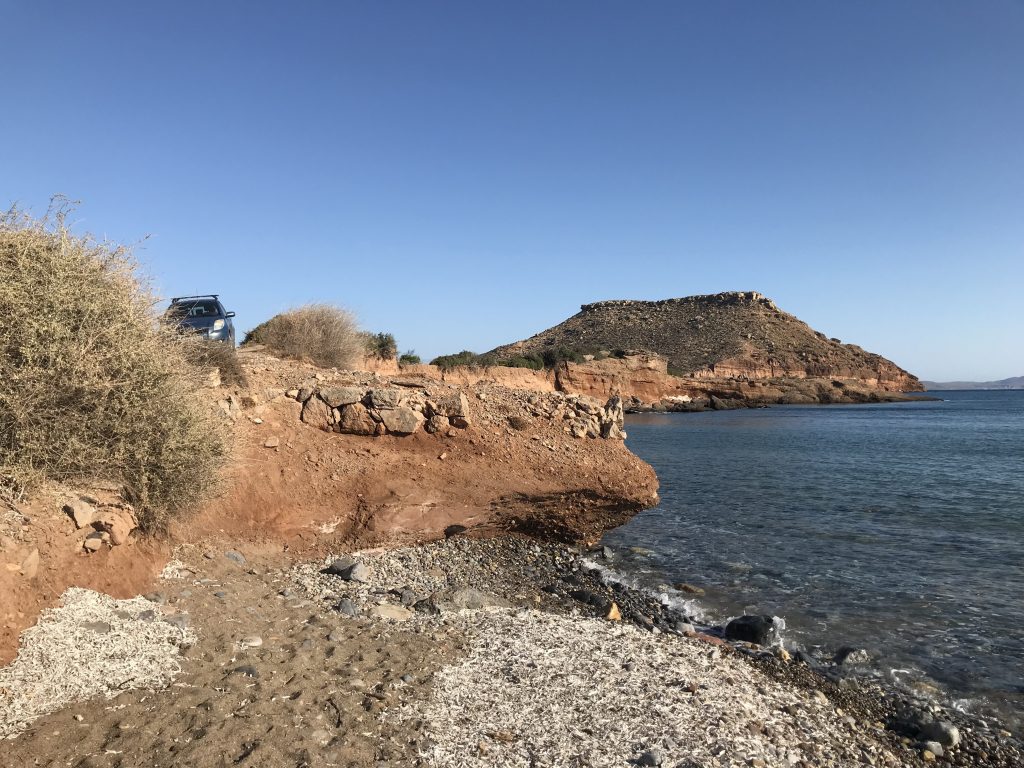
Minoan walls above Bodolaki beach, with the hill of Kastri behind.
All images © British School at Athens, Lasithi Ephorate of Antiquities, and Ephorate of Underwater Antiquities
“People often assume that archaeology is only about excavation,” Rachel continues. “But objects also need to be conserved and studied after they come out of the ground.” There is so much more to day-to-day archaeology work than digging. “Archaeology teaches you to handle evidence with care, to question assumptions, and to think expansively about how societies form and change,” says PhD student Jacob De Juliis. “At its core, archaeology is a way of understanding people and their resilience, creativity and humanity, and that makes it endlessly relevant to the world we live in now.”
What does a typical day of work at Palaikastro involve?
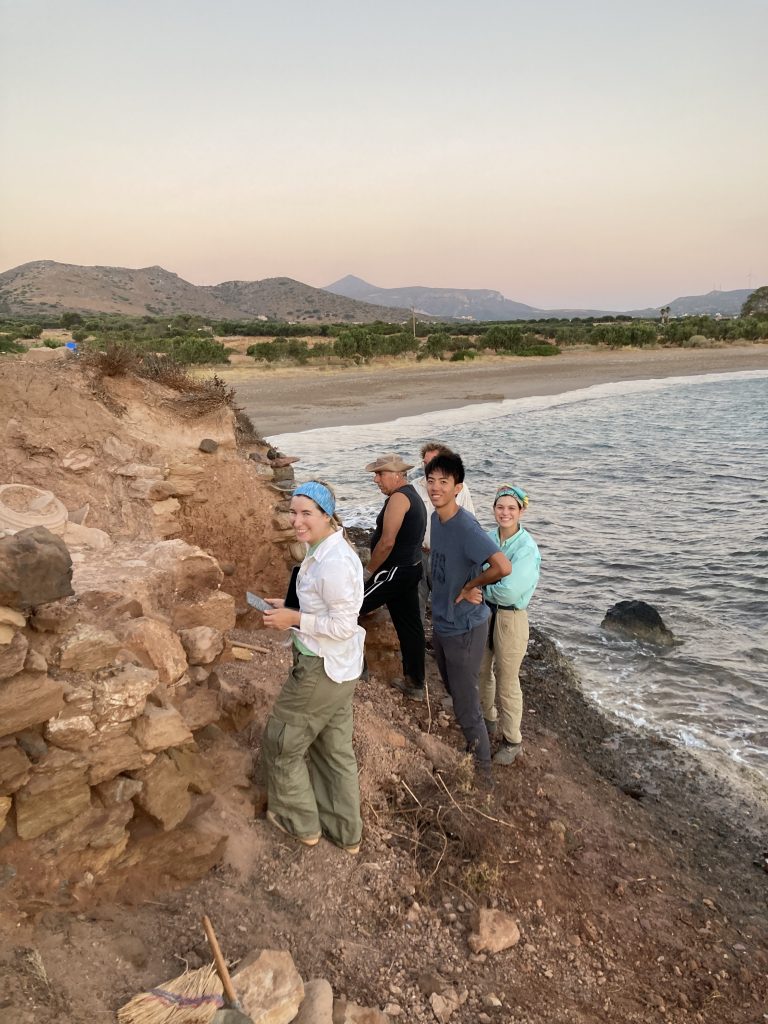
“It gets pretty hot in Greece in the summer, so we start early,” says Carl. “The whole team is on site at 6am and we finish excavating at 2pm.” To excavate the site, the team digs in trenches. Every artefact they discover, down to the smallest sherd, is bagged, labelled and catalogued, then taken to the ‘apotheke’ (storeroom) for analysis. “In the afternoon, we work on the pottery out of the sun in the apotheke,” says Carl. Sometimes, there will be thousands of sherds laid out on tables as the team tries to find pieces that fit together so they can restore whole pots and vases. “It’s a bit like doing several 3D jigsaws at once, but without the picture on the box to guide you!” says Carl. “This can be pretty difficult, especially when you go for hours without finding any joins. But it’s very satisfying in the end once the vase has been put back together. All in all, it’s quite a full day of work, so it’s great to have the sea close by to cool off. And we’re lucky to have a really supportive local village that is invested in this project.”
Pathway from school to archaeology
“There is no single pathway into archaeology,” says Carl. “You can study languages, sciences, history or geography. Archaeology really does encapsulate a wide range of approaches, from philosophy to lab-based science.”
At university, a degree in archaeology would provide a direct route to a career in the field. Or you could study a related degree such as anthropology, history or art history.
“Learning basic digital skills (like photography) will give you a strong foundation,” adds Jacob.
“Visit archaeological sites and museums in your local area,” says Rachel. You can also explore museum collections online, such as those at the Heraklion Archaeological Museum which hosts many artefacts from Palaikastro: heraklionmuseum.gr
Explore careers in archaeology
Volunteer on excavations to get practical experience and learn what a career in archaeology involves. “If you get the chance to participate in a field school, go with an open mind and remember that some of the most important work is behind the scenes,” advises Jacob.
“There is so much breadth of opportunity to study whichever time or part of the world you are most interested in,” says Zoë Arzuman, who worked at Palaikastro as a student. “Archaeology teaches you many specialised skills to study the past. It is expansive in both what part of the past you want to study, and what tools you use to do so.”
Explore the websites of archaeology organisations such as the Canadian Archaeological Association (canadianarchaeology.com), the British Archaeological Association (thebaa.org) and the Society for American Archaeologists (saa.org) to learn about current research and to find fieldwork opportunities.
Meet the team
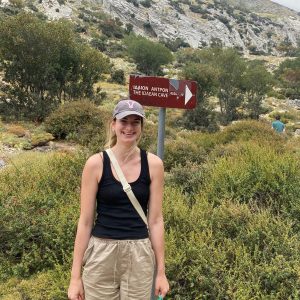 Zoë Arzuman
Research Assistant, University of Toronto, Canada
When I think of Palaikastro, my mind often goes to memories of watching the sun rise over the Aegean Sea and hearing crashing waves next to our dig trench. I also think of the close friends I made – we still meet for lunch and take trips together.
I spent six weeks excavating at Palaikastro during the summer of 2022. Since then, I’ve spent two summers working at the Heraklion Archaeological Museum, where I helped catalogue pottery which had been excavated from Palaikastro over 100 years ago. Each vessel description (including what it is made of and what decoration is present) contributes to a fuller understanding of what the lives of the people at Palaikastro were like during the Bronze Age.
Say yes to every opportunity, because you never know where it will take you. When I started university, I didn’t imagine myself as an archaeologist. But working at Palaikastro led me to a place where I can imagine myself as an archaeologist studying Aegean prehistory for years to come.
 Jacob De Juliis
PhD Student, University of Toronto, Canada
My role at Palaikastro involves the careful digital documentation and management of artefacts by creating a coherent digital record that preserves each object’s condition, origin and features. While less glamorous than some aspects of archaeology, this job ensures that the material culture remains accessible for future study, comparative analysis and long-term conservation.
Working at Palaikastro is truly a dream, thanks to the people I’ve met there – and the fact that I get to work side by side with my best friend! The opportunities you have and friendships you form during archaeological fieldwork are truly unmatched.
Archaeology lets me bring together the two forces that shaped me – a fascination with deep time, which I inherited from my father who works in palaeontology, and a commitment to human stories and lived experience, shaped by my mother’s work with refugee communities. Archaeology sits exactly at that intersection as it asks how people lived, adapted, created and connected across vast spans of time, and why their choices still matter today.
 Dr Rachel Phillips
Researcher, British School at Athens, Greece
As an archaeologist at the British School at Athens, I work on the pottery found in the excavations at Palaikastro, helping to identify and catalogue the different vessels. I write down the shape and size of the pot, the kind of clay it’s made from, and any decoration it has.
Some vessels are found intact and so are easier to identify (to work out what kind of cup or jar it is, for example), but some are just tiny fragments. However, even these fragments can help us to date a building more precisely or tell us how it was used by people in the past.
Palaikastro is a beautiful place to work, close to the mountains and the sea. But my favourite thing about working at Palaikastro is the people that I’ve met. Archaeological fieldwork offers an opportunity to meet people from all over the world, to make new friends, and to be part of a community of people interested in similar things.
Do you have a question for Carl, Zoë, Jacob or Rachel?
Write it in the comments box below and they will get back to you. (Remember, researchers are very busy people, so you may have to wait a few days.)
Discover how archaeologists are excavating a Mayan settlement in Belize:
futurumcareers.com/how-are-archaeologists-uncovering-the-secrets-of-an-ancestral-maya-boomtown
The post What can pottery from the past teach us about containment today? appeared first on Futurum.
“}]]