
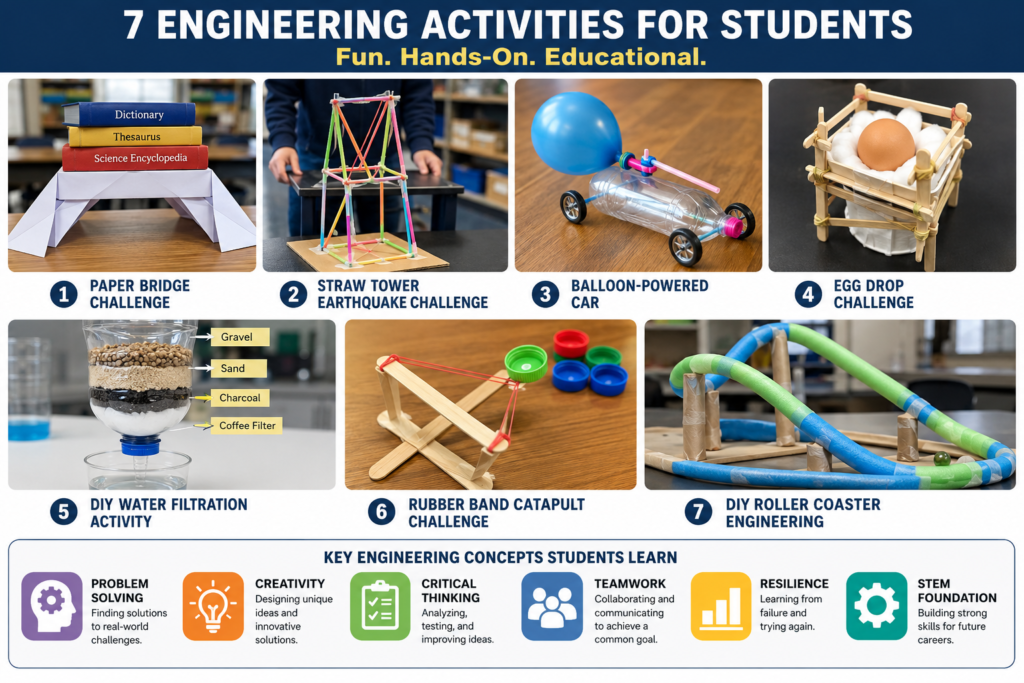
Engineering Activities for Students That Quietly Build Confidence, Creativity, and Real-World Intelligence
[[{“value”:”
Something powerful happens when students stop memorizing answers and start building solutions with their own hands.
A paper bridge bends under pressure.
A balloon-powered car veers sideways across the floor.
A carefully designed tower collapses in seconds.
And somehow, those moments teach more than an entire worksheet ever could.
Engineering activities change the way students think because they force the brain into motion. Instead of passively absorbing information, students begin testing ideas, predicting outcomes, solving problems, adapting to failure, and discovering patterns on their own. Learning becomes active. Personal. Memorable.
That’s why engineering-based learning has become one of the most effective ways to develop critical thinking, resilience, collaboration, and creativity in modern education.
The experience doesn’t just teach STEM concepts. It teaches students how to approach challenges in life.
Why Engineering Activities Feel Different From Traditional Learning
Most traditional classroom learning focuses on finding the correct answer.
Engineering focuses on discovering better answers.
That distinction matters more than people realize.
When students engage in engineering challenges, they enter a process filled with uncertainty, experimentation, and decision-making. They become emotionally invested because the outcome depends on their own thinking.
The brain responds differently when learning feels connected to action.
Students begin using:
- Logical reasoning
- Creative problem-solving
- Spatial awareness
- Communication skills
- Analytical thinking
- Trial-and-error adaptation
And because engineering projects are physical and interactive, the learning tends to stick. Students remember what they built because they experienced it, not because they memorized it.
The Real Lesson Hidden Inside Every Engineering Challenge
At first glance, engineering activities look simple.
Build a bridge.
Protect an egg.
Create a tower.
Launch a marble.
But beneath the surface, students are quietly learning one of the most valuable mental frameworks in the world: the engineering design process.
They start by identifying a problem.
Then they brainstorm possibilities, sketch ideas, test materials, build prototypes, observe failures, and redesign their solutions.
Without realizing it, students begin thinking like inventors.
And maybe more importantly, they start understanding that failure isn’t proof they’re incapable.
It’s information. That mindset shift can completely change how students approach learning.
7 Engineering Activities for Students That Actually Spark Deep Learning
1. The Paper Bridge Challenge
There’s something oddly exciting about watching a simple sheet of paper hold unexpected amounts of weight.
Students quickly discover that structure matters more than appearance.
A flat bridge folds instantly.
A carefully designed folded structure becomes surprisingly strong.
What Students Learn
- Load distribution
- Structural reinforcement
- Compression and tension
- Basic civil engineering principles
Materials Needed
- Printer paper
- Tape
- Coins or books
- Rulers
The best part is watching students redesign their bridges after the first attempt fails. That redesign process is where the deepest learning happens.
2. Straw Towers and Earthquake Simulations
This activity starts innocently enough.
Students build tall towers from straws and tape. Then comes the moment everyone waits for — the earthquake test.
The shaking begins.
Towers wobble.
Some survive.
Most don’t.
And suddenly the room becomes fully engaged.
Concepts Students Absorb Naturally
- Structural stability
- Force distribution
- Balance and center of gravity
- Seismic engineering concepts
Students begin asking smarter questions almost immediately:
“What shape is strongest?”
“Why did this side collapse first?”
“How do real buildings survive earthquakes?”
That curiosity creates real learning momentum.
3. Balloon-Powered Cars
Few engineering activities create faster excitement than balloon-powered cars.
Students inflate balloons, release the air, and watch their handmade vehicles race across the floor. It feels playful at first, but underneath the fun, students are exploring complex ideas involving motion, propulsion, and friction.
Skills Developed
- Mechanical engineering fundamentals
- Aerodynamics
- Motion mechanics
- Experimental testing
Students naturally start modifying wheel size, weight distribution, and airflow direction without being prompted.
That’s authentic engineering thinking in real time.
4. The Classic Egg Drop Challenge
This activity has survived generations for a reason.
Students become deeply attached to protecting something fragile. The emotional stakes instantly raise engagement levels.
Every student believes their design will work.
Then gravity decides otherwise.
Engineering Principles Hidden Inside the Challenge
- Impact absorption
- Energy transfer
- Material strength
- Protective design systems
But the real value appears after the egg breaks.
Students begin analyzing what failed instead of simply feeling defeated. That emotional reframing — from embarrassment to curiosity — is one of the most important outcomes engineering activities can create.
5. DIY Water Filtration Projects
Some engineering activities feel especially meaningful because students immediately recognize their real-world importance.
Water filtration challenges do exactly that.
Students build systems using sand, charcoal, gravel, and filters to clean contaminated water samples.
As they experiment, they begin understanding how engineering directly affects health, sustainability, and human survival.
Concepts Explored
- Environmental engineering
- Filtration systems
- Sustainability
- Resource management
This activity often sparks conversations far beyond science class. Students begin thinking about global water access, environmental responsibility, and innovation in entirely new ways
6. Rubber Band Catapult Challenges
At first, students focus entirely on launching objects as far as possible.
Then accuracy becomes the obsession.
Tiny adjustments suddenly matter:
- Launch angle
- Rubber band tension
- Weight balance
- Projectile shape
Students unknowingly begin performing controlled experimentation.
Skills Strengthened
- Precision engineering
- Force and trajectory understanding
- Hypothesis testing
- Mechanical systems thinking
The room usually fills with laughter, competition, and rapid redesign cycles — all signs of highly engaged learning
7. DIY Roller Coaster Engineering
Marble roller coasters turn physics into something students can physically see and feel.
A poorly designed track causes the marble to stall.
A smoother slope increases momentum.
A sharper curve changes speed dramatically.
Students stop viewing physics as abstract formulas and begin experiencing it directly.
Concepts Learned Through Motion
- Gravity
- Kinetic energy
- Momentum
- Energy transfer systems
The hands-on nature of this activity creates unusually strong memory retention because movement, emotion, and experimentation are happening simultaneously.
Engineering Disciplines Students Explore Without Even Realizing It
One of the most fascinating parts of engineering education is how naturally it introduces students to different career pathways.
A bridge project quietly introduces civil engineering.
A moving machine becomes an introduction to mechanical engineering.
A paper airplane challenge touches aerospace engineering.
A water filtration system opens the door to environmental engineering.
Students begin discovering where their interests naturally pull them.
That exploration matters early.
Because confidence often grows fastest when students can see themselves inside a future possibility.
Why Engineering Activities Often Reach Students Traditional Lessons Don’t
Some students struggle in conventional academic settings because passive learning doesn’t match how their brains engage with information.
Engineering changes the environment completely.
Students can:
- Move
- Build
- Test
- Collaborate
- Experiment
- Fail safely
- Improve visibly
The feedback becomes immediate and tangible.
And because there’s rarely one perfect solution, students feel less pressure to “get it right” instantly.
That freedom encourages participation from students who might otherwise stay disengaged.
The Confidence Shift That Changes Everything
The biggest transformation isn’t always academic.
It’s emotional.
Students who once avoided challenges start leaning into them. They begin viewing obstacles as puzzles instead of proof of failure.
A tower collapses?
Adjust the base.
The balloon car drifts sideways?
Fix the wheel alignment.
The bridge bends?
Reinforce the support structure.
Over time, students quietly develop resilience.
And resilience becomes one of the most valuable life skills any classroom can offer.
How Parents and Teachers Can Make Engineering Activities More Powerful
Let Students Struggle a Little
It’s tempting to step in quickly when something isn’t working.
But productive struggle is where deeper thinking develops. Students grow faster when they analyze problems independently before receiving solutions
Ask Questions Instead of Giving Answers
Simple questions unlock powerful thinking:
- “What do you notice happening?”
- “Why do you think it failed?”
- “What could you change next?”
- “What pattern are you seeing?”
Questions build thinkers. Answers often end the thinking process too early.
Celebrate Redesigns, Not Just Success
The strongest engineering classrooms reward improvement.
Students should feel proud when Version 2 works better than Version 1.
That teaches adaptation instead of perfectionism.
Connect Activities to Real Life
Engineering exists everywhere:
- Buildings
- Transportation
- Smartphones
- Medical devices
- Renewable energy systems
- Water infrastructure
The more relevant the activity feels, the more emotionally invested students become.
Questions Students and Parents Often Ask About Engineering Activities
What age should students begin engineering activities?
Even very young children can begin simple engineering projects using building blocks, paper structures, ramps, and beginner design challenges. Complexity can increase naturally as students grow older
Do engineering activities require expensive materials?
Not at all.
Some of the most effective engineering challenges use everyday household items like cardboard, paper, tape, straws, rubber bands, and recycled materials.
Can engineering activities improve school performance?
Yes. Engineering strengthens problem-solving, logical reasoning, collaboration, creativity, and analytical thinking — all skills that support broader academic success
What’s the best beginner engineering activity?
Paper bridge challenges and balloon-powered cars are excellent starting points because students see immediate results while learning important engineering principles naturally
Why are hands-on engineering projects so effective?
Because students learn best when they actively participate in the learning process. Building, testing, failing, and improving creates stronger understanding and longer-lasting retention than passive instruction alone.
Products / Tools / Resources
- LEGO Education STEM Kits — excellent for introducing structured engineering concepts through creative building
- Snap Circuits — beginner-friendly electrical engineering activities for younger students
- K’NEX Education Sets — ideal for bridge, tower, and motion-based engineering challenges
- KiwiCo Engineering Crates — monthly hands-on STEM projects with guided learning
- Straw Constructor Kits — affordable classroom engineering tools for structural design activities
- Tinkercad by Autodesk — free beginner-friendly 3D design platform for student engineering projects
- NASA STEM Resources — free aerospace engineering activities and classroom lesson plans
- PhET Interactive Simulations — physics and engineering simulations designed for visual learners
Source workflow and prompt architecture:
“}]]