
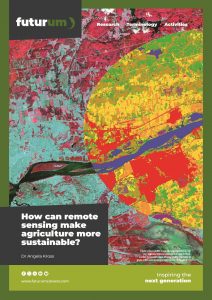
How can remote sensing make agriculture more sustainable?
[[{“value”:”
How can remote sensing make agriculture more sustainable?
Agriculture is essential for feeding the world’s population. However, the land clearance, chemicals and intensive working of the soil that come with it can all cause significant damage to the environment. To make agriculture more sustainable, Dr Angela Kross from Concordia University in Canada, is investigating how remote sensing technologies can be used to monitor the environmental impacts of agriculture.
Talk like a remote sensing researcher
Eutrophication — the process that occurs when too many nutrients enter the water (for example due to fertiliser being washed off fields), causing excessive algae growth that leads to a lack of oxygen in the water
Reflectance value — how much light is reflected from a surface
Remote sensing — the science of collecting information about Earth’s surface, oceans and atmosphere from a distance, typically using sensors on satellites, aircraft or drones
Spectral signature — the unique pattern of light that a material reflects or absorbs at different wavelengths
Spectral vegetation index — a mathematical value calculated from remotely sensed spectral data, which indicates vegetation properties such as health or density
When forests and wetlands are cleared for farming, wildlife habitats are lost, biodiversity declines and soils become more vulnerable to erosion. Agriculture damages water quality when chemicals wash into waterways, as pesticides kill organisms and fertilisers causes eutrophication which harms aquatic life. And poor soil management can lead to erosion and loss of stored carbon. Together, these pressures can seriously affect ecosystems and long-term food production.
“Agriculture is essential for food security and livelihoods,” says Dr Angela Kross, a remote sensing scientist at Concordia University who uses Earth observation technologies to study agricultural systems. “Agriculture is also one of the largest drivers of environmental change. It affects biodiversity, soils, water and climate, and is responsible for 10-12% of global anthropogenic greenhouse gas emissions. My research aims to make these impacts visible and measurable so they can be managed more effectively.”
How does Angela analyse remote sensing images?
Remote sensing involves taking measurements from a distance, typically using satellites, aircraft or drones. Angela uses a mix of satellite and field-based technologies to study vegetation and environmental properties at different scales. “Remote sensing technologies measure how the Earth’s surface reflects sunlight in different wavelengths of the electromagnetic spectrum, such as visible light and near-infrared wavelengths,” explains Angela.
At the field scale, Angela collects data using drones equipped with red-green-blue cameras and thermal cameras. Red-green-blue cameras produce true-colour images by recording red, green and blue light, just like human eyes do. Thermal cameras measure infrared radiation and record temperature differences, which allows Angela to identify crop stress and wildfires. At the wider scale, Angela uses images collected by satellites.
To analyse the images produced by remote sensing cameras, Angela interprets patterns called spectral signatures. “Spectral signatures show how different surfaces, such as vegetation, soil or water, interact with sunlight by absorbing, reflecting or emitting energy across various wavelengths,” she explains. “Each material has its own ‘spectral fingerprint’ in the electromagnetic spectrum, allowing me to identify what is on the ground and assess its condition. Interpreting these signatures allows me to monitor plant health and reveal information that would otherwise remain invisible to the human eye.”
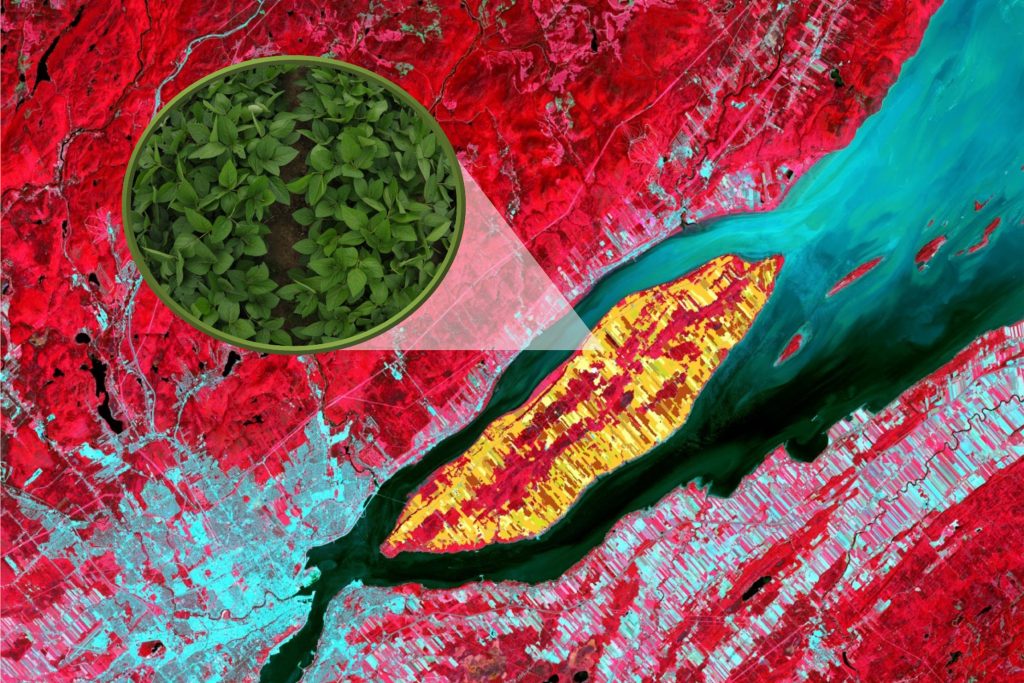
Spectral signatures guide the creation of colour composite images and the calculation of spectral vegetation indices. For example, in some false-colour satellite images, near-infrared light (which humans cannot see) is displayed as red. Healthy vegetation reflects a large amount of near-infrared radiation, so it appears bright red, making differences in plant health easy to visualise.
Spectral vegetation indices build on the same idea by converting the complex data from spectral signatures into simple numerical values. “This is done by mathematically combining reflectance values from specific parts of a spectral signature, usually wavelengths where the differences between healthy vegetation, stressed vegetation, soil or water are most pronounced,” Angela explains. The most well-known index is the normalised difference vegetation index (NDVI), which gives a simple score that indicates vegetation health based on how plants reflect red and near-infrared light. Healthy, leafy vegetation absorbs red light for photosynthesis and reflects near-infrared light, so NDVI values are high. In contrast, stressed, sparse or non-vegetated areas have low or negative NDVI values. NDVI is widely used by scientists but it has limitations, so many other indices have been developed to study different crops and environmental properties.
These indices are used as model inputs so satellite images can estimate real-world measurements of variables such as crop water content (an indicator of crop stress). “It’s important that remote sensing models are validated with data from the ground,” says Angela. “For example, we can develop models based on the relationship between spectral indices and chlorophyll concentration (an indicator of eutrophication) measured from water samples, then apply the validated model to satellite images to map chlorophyll concentration in lakes and locate areas contributing to nutrient runoff.”
Reference
https://doi.org/10.33424/FUTURUM675
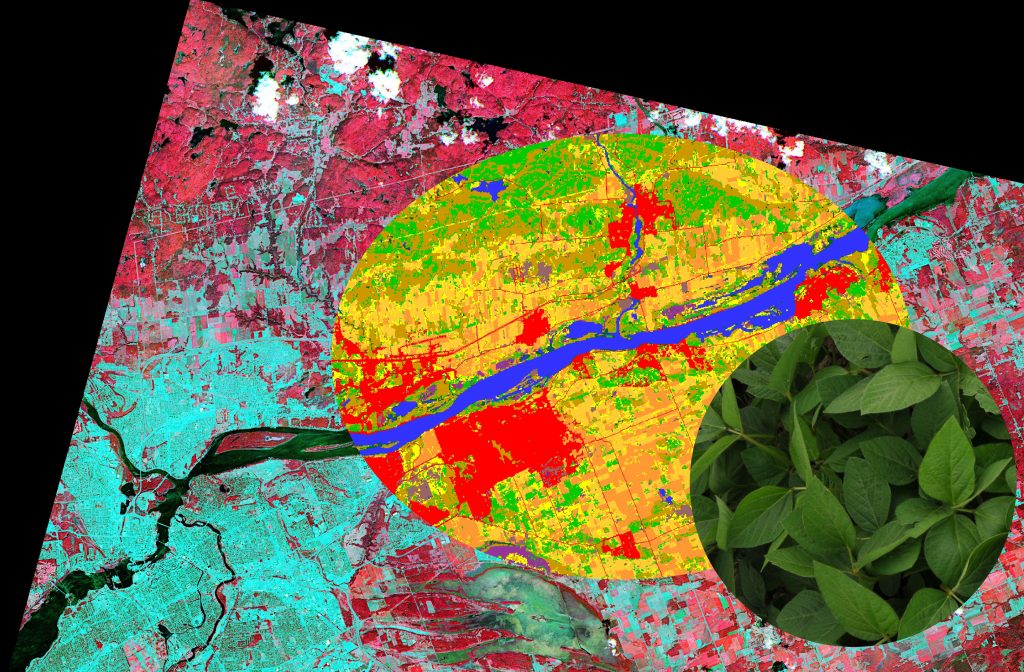
A false-colour satellite image showing vegetation in red, non-vegetated areas in turquoise and water in black, overlain by a model output showing healthy vegetation in green, urban areas in red and water in blue.
© Angela Kross
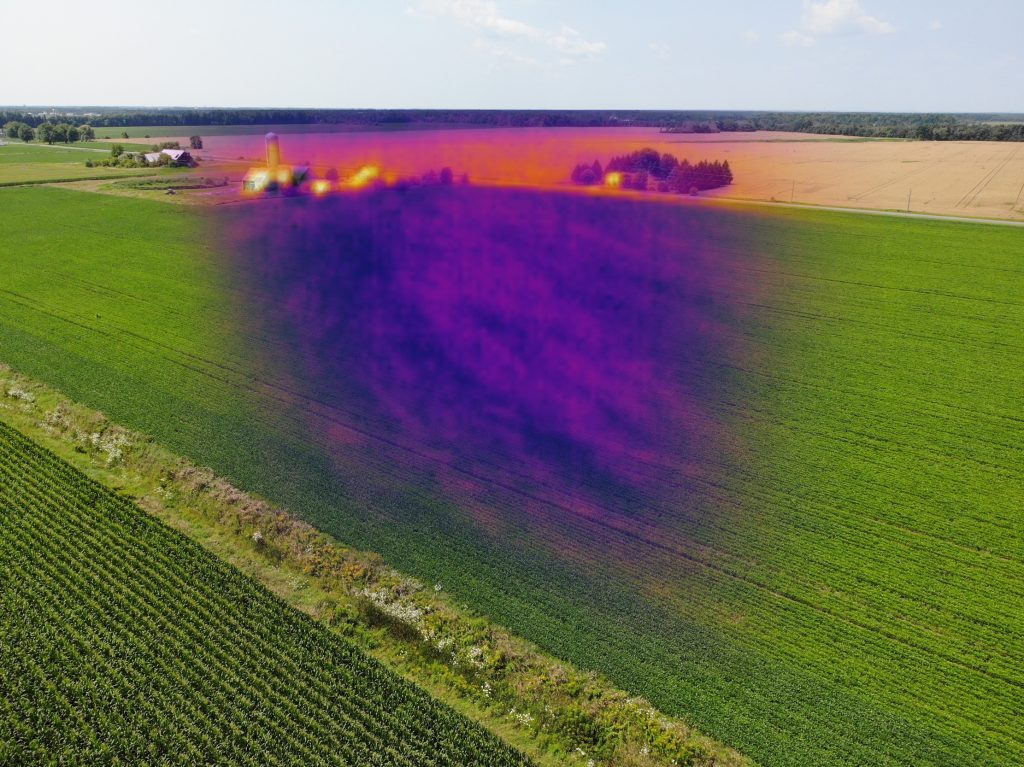
A thermal image overlain on a true-colour image showing heat sources on a farm.
© Angela Kross
How can remote sensing make agriculture more sustainable?
Remote sensing provides spatially and temporally continuous information on environmental variables affected by agricultural practices, such as biodiversity, water, soil and crop health. By transforming satellite observations into meaningful environmental indicators, remote sensing can provide large-scale estimates of environmental conditions that would otherwise require extensive ground data collection. This makes it possible to identify areas of concern and guide management actions.
Beyond its practical value, the ability to reveal information that cannot be seen directly is one of the most powerful aspects of remote sensing. “I love how remote sensing makes the invisible visible!” says Angela. “Remote sensing reveals hidden patterns in plants, soils, water and whole ecosystems that our eyes could never detect alone. It is a constant reminder that the world around us is so much richer than what we can perceive with our senses.” These hidden patterns provide clues about biodiversity, water pollution, plant health and soil conditions.
Angela believes that remote sensing technologies should be incorporated into agricultural environmental impact assessments so that farmers can monitor how agricultural practices are affecting the environment. “I want remote sensing to become a practical, accessible tool that helps align agricultural production, biodiversity conservation and climate goals, rather than treating them as competing objectives,” says Angela. “Ultimately, I hope my research will help make agriculture more sustainable by giving farmers tailored information about where environmental risks (such as erosion hotspots and biodiversity conflict zones) are highest. I also hope remote sensing of environmental indicators will be integrated into routine monitoring and policy tools, such as agricultural environmental impact assessments, to improve the sustainability of agriculture.”
 Dr Angela Kross
Department of Geography, Planning and Environment, Concordia University, Canada
Fields of research: Remote sensing; environmental sciences; ecology; geography
Research project: Advancing multi-sensor and multi-source data integration methods for improved characterisation and quantification of crop development and its impacts on the environment
Funder: Natural Sciences and Engineering Research Council of Canada (NSERC) Discovery Grant number RGPIN-2023-05646
Do you have a question for Angela?
Write it in the comments box below and they will get back to you. (Remember, researchers are very busy people, so you may have to wait a few days.)
Learn how famers in Alaska are using remote sensing to help address the challenges of farming on permafrost:
The post How can remote sensing make agriculture more sustainable? appeared first on Futurum.
“}]]